Top 4 Cookie Consent Tool Alternatives 2026

Navigating cookie consent management for regulatory compliance creates confusion around core features, supported jurisdictions, and technical integrations. Many tools either restrict access to essential compliance features on the free tier or require developer intervention for advanced integrations, increasing cost and complexity for agencies and site owners. This comparison details standards support, automation, language coverage, and integrations so website owners, marketers, and agencies can select a cookie consent tool that matches compliance and scale needs.
Table of Contents
Passiro
At a Glance
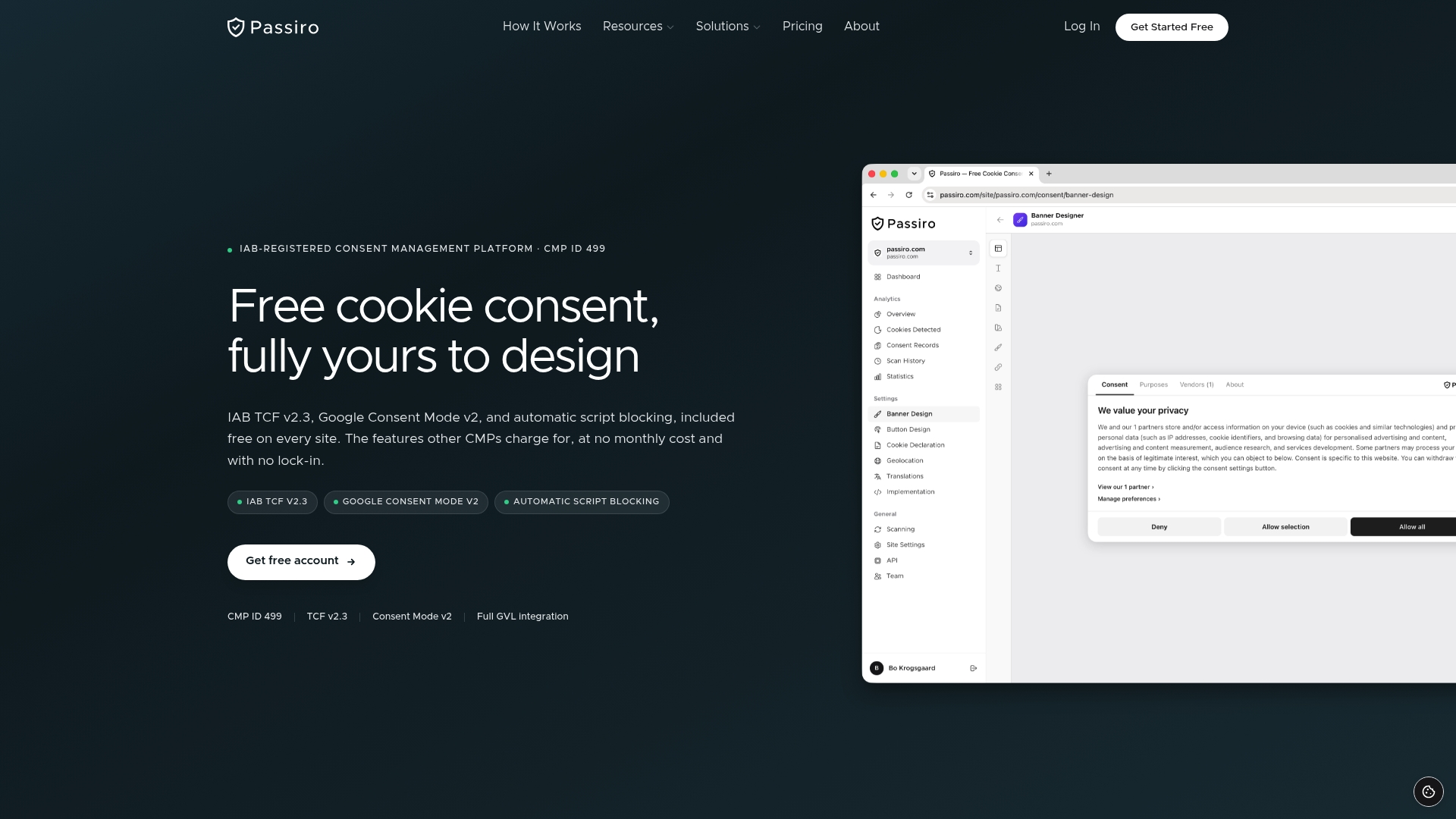
Core consent features are free and open source and include IAB TCF v2.3 and Google Consent Mode v2 support. The product offers automatic script blocking until consent is granted and records consent for auditing. It is built in Europe and ships with broad multilingual support and fast loading.
Core Features
Passiro produces IAB TCF v2.3 consent strings and integrates with Google Consent Mode v2 while blocking scripts automatically until users grant permission. It supports per vendor consent using the Global Vendor List, cross frame messaging, and the tcfapi() API for vendor communication. The banner system includes a visual editor, a stock library, consent records, and a simple one line embed for rapid deployment across platforms.
Key Differentiator
Passiro’s defining advantage is that the core consent management stack supports industry standard TCF v2.3 and full Google Consent Mode v2 at no cost. That means sites can implement a standards compliant consent mechanism without paying for basic compliance features. The product also scales from single WordPress installs to agency deployments across many client domains.
Pros
The free core plugin includes TCF v2.3 and Google Consent Mode v2 support, which reduces license spend for compliance projects. Automatic tracker blocking uses an open source list to stop tags until consent is given, and consent records are stored for audit readiness. There are no page or traffic limits on the free tier, and the one line embed makes rollout fast across multiple sites. Customizable banner design and 25 language options let agencies match client branding and multilingual requirements.
Cons
- Advanced features such as automated cookie scanning, API access, branding removal, and premium support require paid plans, so larger teams will need to budget for those extras.
Who It’s For
Passiro fits website owners, small and medium sized businesses, and digital agencies that need standards based consent without enterprise pricing. Hosting providers who add compliance as a service will find the no page limit free tier useful. E commerce stores operating in Europe that require GDPR and ePrivacy alignment also match this product profile.
Unique Value Proposition
A free core CMP with no page or traffic limits and a one line embed for rapid rollout distinguishes Passiro in practical terms. Agencies can deploy compliant banners across dozens of client domains without recurring core fees. The open source core reduces vendor lock in and the EU origin addresses data residency and privacy expectations when that matters.
Real World Use Case
A digital agency deploys Passiro across all client sites to meet GDPR requirements and support Google Ads conversion tracking via Consent Mode. The team uses the visual banner editor to match client branding and relies on consent records for audits. Clients avoid per site licensing costs for basic consent management.
Pricing
Passiro offers a free core plan that includes TCF v2.3, Google Consent Mode v2, automatic script blocking, and unlimited pages. Paid tiers add cookie scanning, API access, branding removal, and premium support for teams that need those features. Enterprise level services and dedicated support are available on paid plans.
Website: https://passiro.com
CookieYes
At a Glance
CookieYes reports being trusted by over 1.5 million businesses worldwide. That figure highlights broad adoption among small shops and agency clients. The platform bundles automated cookie scanning, consent logging, and multi language banners suitable for regional compliance.
Core Features
CookieYes delivers automated cookie scanning and detailed audit reports, plus automatic blocking of cookies until consent is given. It includes customizable banners with multiple layouts and language support, consent logs for proof, and policy generation tools. CMS plugins and apps make deployment across sites faster for teams with limited engineering time.
Key Differentiator
The vendor advertises that it is a Certified Google CMP with support for IAB TCF v2.3 and geo target capabilities. That certification claim pairs with native support for Google Consent Mode and tag management integrations. The combination reduces lift for sites that must align with both Google requirements and programmatic consent frameworks.
Pros
Deployment is straightforward thanks to lightweight code snippets and ready made CMS plugins, which speeds setup on WordPress and similar platforms. Customizable banner templates let brands match tone and language without writing front end code. Automation features reduce manual cookie audits and reporting work. The vendor advertises high user satisfaction scores, and the product includes consent logging for audit trails and regulatory records.
Cons
- Pricing structure can be complex for enterprises managing many domains and client accounts. This complexity can increase procurement time.
- The free plan is limited and does not include the full automated scanning and enterprise features. Paid plans unlock the full toolset.
- Advanced customizations and some integrations may require developer support, which raises implementation time and cost for non technical teams.
When It May Not Fit
Large agencies that need consolidated billing and white label features across hundreds of client domains may find the tiering complex. Teams without developer resources will struggle with deep customizations. Organizations that require features only available in high traffic plans should plan for additional budget.
Notable Integrations
CookieYes integrates with Google Tag Manager, Google Consent Mode, IAB TCF v2.3, and Microsoft UET. These integrations enable coordinated tag firing and consent signals across marketing and analytics stacks. They reduce the need for manual tag rework when consent changes.
Who It’s For
Website owners, marketers, and small to mid sized agencies that need an out of the box cookie consent solution with regional rule support. It fits teams that want fast deployment via CMS plugins and measurable consent records for audits. It also fits sites that require Google compatibility and programmatic consent support.
Real World Use Case
A retail company added CookieYes to its online store to scan cookies automatically and block third party scripts until consent was granted. The tool generated compliance reports and maintained consent logs for GDPR and CCPA inquiries. That workflow cut manual auditing work for the compliance team.
Pricing
CookieYes offers a free plan with limited features. Paid plans start at $10/month for small websites, with higher tiers for high traffic sites and agencies. Larger plans include enterprise features, scanning frequency increases, and multi domain management.
Website: https://cookieyes.com
CookieFirst
At a Glance
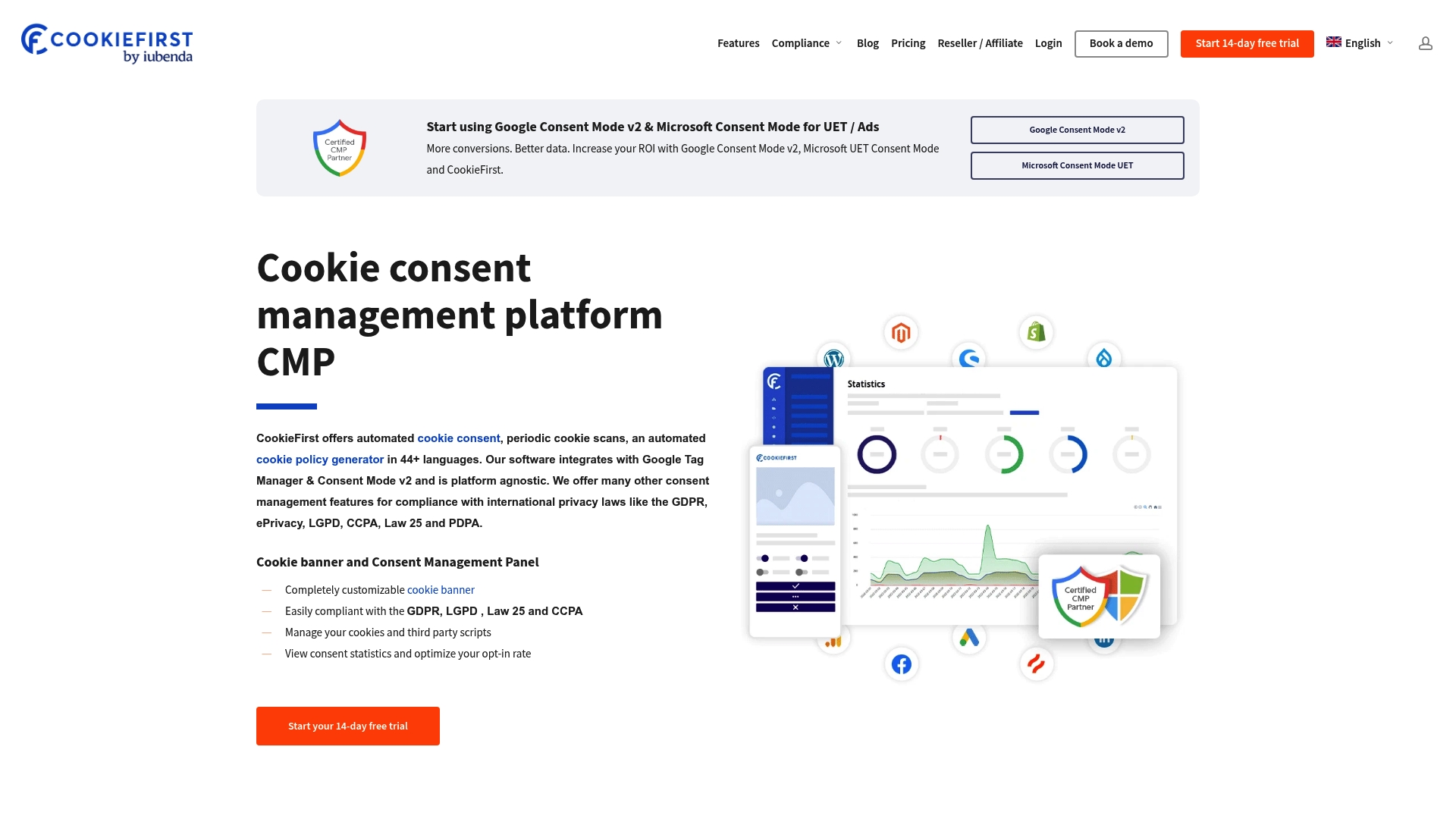
Generates cookie policies in 44 languages to support localized compliance across markets. CookieFirst combines automated cookie scans with customizable banners, and consent logging. The product targets site owners who must manage GDPR, CCPA, LGPD, and ePrivacy obligations across multiple domains.
Core Features
CookieFirst runs automated cookie scans and maps scripts to consent categories while offering a multi-language policy generator. It includes customizable banners, granular consent controls, and consent statistics for optimization. The platform integrates with Google Tag Manager and Consent Mode v2 and supports platform-agnostic script control in diverse web environments.
Key Differentiator
CookieFirst centers on multi-language policy generation paired with automated scanning and platform-agnostic integrations. That combination reduces manual review when sites serve multiple jurisdictions. The integration focus extends to tag management and consent mode support for measurement workflows.
Pros
CookieFirst delivers broad privacy law coverage that addresses GDPR, CCPA, LGPD, and ePrivacy requirements in a single product. Its automated scan and policy generator cut manual tagging work and speed up localization for multilingual sites. Customizable banners and granular consent controls give web teams control over scripts and user choices, and built-in consent statistics help refine opt-in configurations.
Cons
- Pricing is tiered and can become costly for very high traffic sites that exceed free plan limits.
- Advanced script control and third-party plugin compatibility may require technical setup and developer time.
- The free plan restricts features and page views, so larger sites will likely need to upgrade to paid tiers.
When It May Not Fit
Sites that need a completely out-of-the-box solution with minimal developer involvement may find the setup too technical. Very high-traffic publishers should budget for paid tiers because the free plan enforces page view limits. Environments relying on proprietary third-party plugins for script control may face integration gaps without custom work.
Notable Integrations
CookieFirst connects to Google Tag Manager and supports Google Consent Mode v2 for measurement control. It provides WordPress Consent API support for native WordPress implementations. These integrations cover common tag and content management workflows used by marketing and development teams.
Who It’s For
Website owners and digital marketing teams that operate across regions and need localized consent management benefit from CookieFirst. Web developers implementing consent flows and agencies managing multiple client domains gain from the platform-agnostic approach. Organizations that require multi-language policy output will find the generator useful.
Real World Use Case
A European e-commerce site deploys CookieFirst to present localized banners across several country subfolders. The team uses automated scans to classify cookies, sends triggers to Google Tag Manager, and monitors consent statistics to tune banner options. That setup reduced manual policy creation while preserving tracking control.
Pricing
CookieFirst offers a Free tier and paid plans starting at €9/month for Basic and €19/month for Plus. Enterprise pricing is available via custom quote for high-volume or bespoke requirements.
Website: https://cookiefirst.com
CookieHub CMP
At a Glance
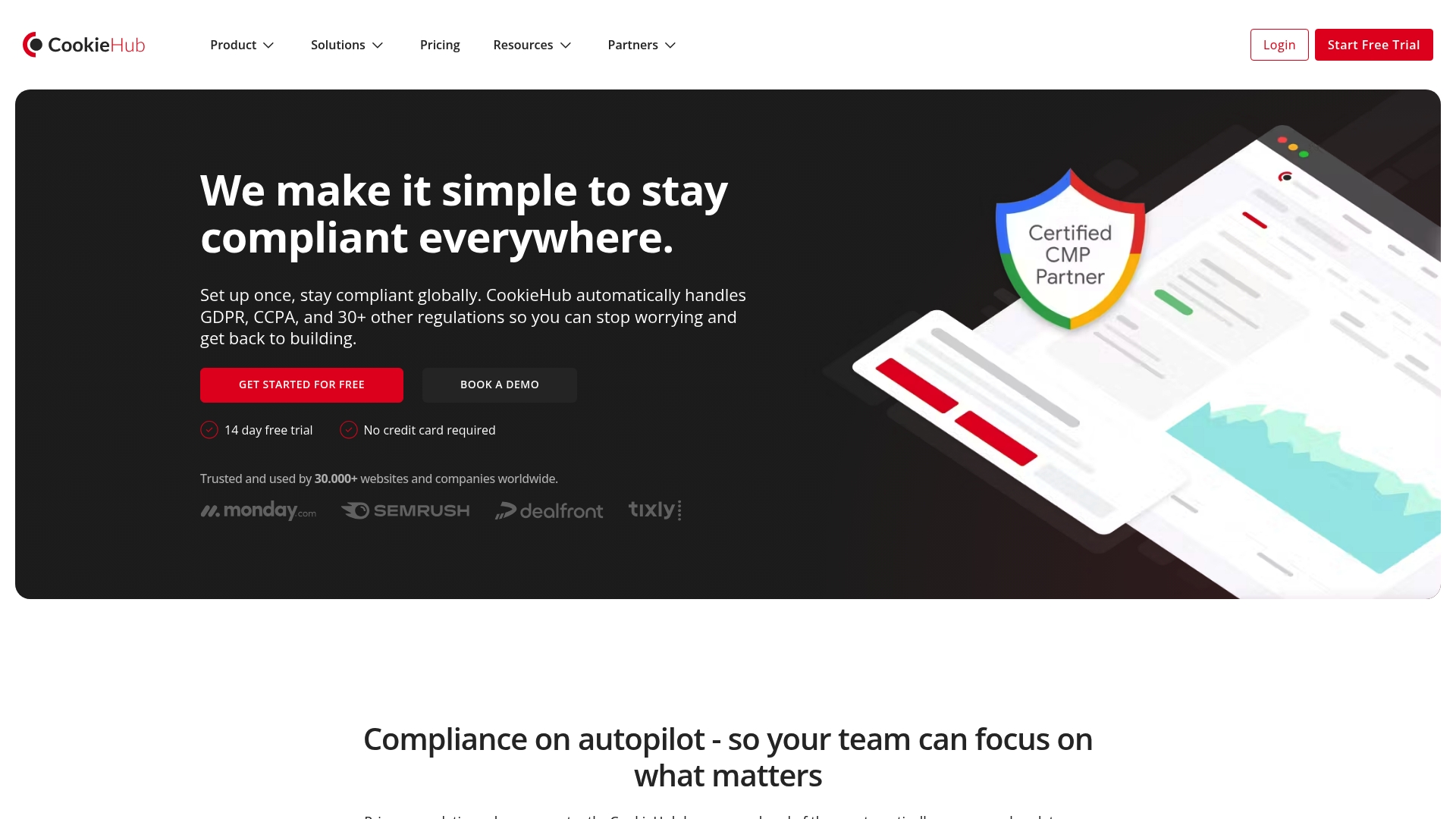
CookieHub reports it is trusted by over 30,000 websites globally. That level of scale shows the product aims at organizations operating across multiple markets. The platform advertises automated cookie detection, regional banner delivery, and audit logs that support GDPR and CCPA workflows. These capabilities suit sites that need repeatable proof of consent across many domains.
Core Features
CookieHub combines automatic cookie blocking with geo targeted consent banners and regular scans that discover and categorize trackers. The platform supports Google Consent Mode v2 and IAB TCF 2.3 while offering customizable consent UI and branded messaging for localized audiences. Reporting features produce audit logs and compliance records that feed analytics and legal documentation.
Key Differentiator
The product differentiates on its emphasis on fully automated, global compliance and its Google Certified Consent Mode v2 support, which the vendor states. That focus pairs with ready plugins and API options for common content management systems. The result is a tool built for organizations that must serve consistent consent rules across many country specific sites.
Pros
Implementation works quickly for common platforms because CookieHub provides plugins for WordPress, Wix, Shopify, and others. That plugin ecosystem reduces manual tagging work and simplifies initial deployment. The platform reports wide adoption, which suggests maturity in real world integrations and template designs. Robust logging and proof of consent help legal teams produce records for audits and support integration with Google Tag Manager and Matomo Tag Manager.
Cons
-
Setup complexity appears in advanced configurations. Some teams will need developer time to map custom scripts and server side tags.
-
Ongoing regulatory changes require the vendor to push updates. Relying on automatic updates means businesses must monitor compatibility with their bespoke integrations.
-
Pricing can increase with very high traffic. Sites with heavy pageviews or many regional domains should expect higher costs.
When It May Not Fit
Organizations with only a single small site and limited traffic may find the feature set and cost disproportionate to their needs. Teams that lack developer resources will face a learning curve for advanced customizations and server side integrations. Businesses that require a managed privacy solution with hands on service might prefer a provider offering dedicated compliance consulting.
Notable Integrations
CookieHub lists integrations with Google Tag Manager, WordPress, Wix, Shopify, and Matomo Tag Manager. Those connections support common marketing stacks and help propagate consent signals to analytics and ad platforms. Integrations streamline tag control and reduce manual blocking work for standard setups.
Who It’s For
This product fits website owners, digital marketers, and compliance officers who manage privacy across multiple sites or regions. It suits teams that need automated detection and documented proof of consent for audit purposes. Enterprises and agencies that operate many client domains will get the most value from the platform’s multi domain and localization capabilities.
Real World Use Case
A multinational retailer uses CookieHub to scan all regional domains, categorize detected cookies, and serve region specific consent banners. The tool generates compliance reports that the retailer uses to document GDPR, CCPA, and LGPD adherence. Tag signals flow into Google Tag Manager and analytics platforms so marketing teams keep measurement aligned with consent.
Pricing
Pricing starts at €6/month for small sites and scales to custom enterprise plans for larger websites or multi site management. The vendor frames the model as usage and scale based, with enterprise features quoted on request. High traffic volumes can increase the monthly cost.
Website: https://cookiehub.com
Comparison of alternatives
Selecting an effective cookie consent management tool requires a detailed comparison of features, pricing, and user scenarios. This analysis evaluates four noteworthy options, to aid website owners, digital marketers, and compliance teams in making an informed choice.
Key features and performance
Passiro uniquely provides a no-cost core package that supports TCF v2.3 and Google Consent Mode v2, making it a strongly attractive option for organizations prioritizing cost-effectiveness without compromising on compliance standards. On the other hand, CookieYes differentiates itself through its automated cookie scanning and reporting features, which streamline efforts for organizations needing detailed analysis of tracking cookies. Meanwhile, CookieFirst excels in localized compliance support by offering optimized multi-language policy generation, making it a great choice for multinational operations.
Customization and deployment
In terms of customization, Passiro features a highly adaptable visual editor for designing consent banners, aligning various branding needs across multiple domains. Conversely, CookieHub provides integration plugins for platforms like WordPress, Wix, and Shopify, catering to teams utilizing a multitude of CMS options. Furthermore, CookieFirst extends its utility by enabling platform-agnostic script management, reducing dependency on bespoke platforms.
Best fit
- For small to medium businesses or agencies prioritizing cost-efficiency while ensuring compliance with industry standards such as TCF v2.3 and Google Consent Mode, Passiro provides extensive capabilities without recurring fees for essential features.
- Businesses requiring automated cookie scans and detailed compliance reporting should consider CookieYes for its scanning capabilities.
- To support operations across diverse regions with tailored multi-language compliance documents and localized banners, CookieFirst is a suitable choice.
- Enterprises managing numerous client domains via various CMS platforms can benefit from CookieHub’s extensive integration plugins.
- Large organizations seeking enhanced reporting and auditing support for global multidomain setups should evaluate the services offered by CookieHub.
Our pick
Passiro is our recommended choice for organizations seeking to implement an efficient cookie consent management solution that adheres to GDPR and ePrivacy compliance standards. With its no-cost core plan inclusive of essential tools like TCF v2.3 and Google Consent Mode v2, alongside multilingual support and rapid, broad deployment, this platform is exceptional for those balancing efficacy with budget constraints. However, enterprises requiring advanced automated scanning and detailed analytics should evaluate CookieYes as a powerful alternative solution.
When selecting a cookie consent management tool, consider the core features and potential limitations to evaluate the best fit for your compliance needs.
| Product | Core Features | Key Differentiator | Pricing | Notable Limitation |
|---|---|---|---|---|
| Passiro | Free IAB TCF 2.3 integration, multilingual support | Free core plugin with advanced standards compliance | Free core, paid plans available | Advanced features require paid tiers |
| CookieYes | Automated cookie scanning, customizable banners | Certified Google CMP with geo-targeting | Free plan, paid from $10/month | Limited free plan features |
| CookieFirst | Multi-language policies in 44 languages | Automated scanning paired with localization capabilities | Free tier, paid from €9/month | Free plan restricts features and page views |
| CookieHub CMP | Geo-targeted consent banners, IAB TCF 2.3 | Fully automated global compliance with integrations | Paid plans from €6/month | May be costly for high traffic or regional domains |
Choosing Cookie Consent Tools That Fit Small and Medium Businesses
Managing cookie consent across multiple client domains or regional sites often demands a clear and compliant solution without enterprise-level complexity or cost. The article underscores challenges around automated script blocking, audit-ready consent records, and support for global privacy laws like GDPR, CCPA, and ePrivacy.
Passiro directly addresses these pain points by offering a free core consent management stack that includes industry standards such as IAB TCF v2.3 and Google Consent Mode v2. Designed for website owners, small and medium-sized businesses, and digital agencies, Passiro handles unlimited pages and client domains with ease and supports multilingual deployments with customizable banners.
Explore how Passiro meets compliance requirements while eliminating license fees and complexity. Visit Passiro to review features and scale your consent management. Learn more about Passiro’s consent features. Start implementing a compliant cookie consent solution that adapts to your business and agency needs.
FAQ
What features does Passiro offer for cookie consent management?
Passiro offers automatic script blocking until consent is granted, essential for compliance with GDPR and ePrivacy laws. It includes support for IAB TCF v2.3 and Google Consent Mode v2, making it suitable for strict regulatory environments. Website owners can implement this tool without incurring initial costs, allowing easy management of user consent.
How does Passiro compare to CookieYes in terms of functionality?
CookieYes excels with automated cookie scanning and highly customizable banners, which gives it an advantage in setup speed and detailed reporting for cookie management. Passiro, on the other hand, is a great fit for organizations looking for a core consent management solution without the costs associated with licenses. For teams focusing on compliance across numerous sites, Passiro’s free tier makes it easier to manage broad implementations.
Which unique features does Passiro have to support cartoon vendor consent?
The platform supports per vendor consent using the Global Vendor List, which helps organizations maintain compliance varied by vendor requirements. Additionally, it incorporates cross-frame messaging and the tcfapi() API for enhanced communication with vendors. This capability ensures that website owners can tailor their consent parameters according to their specific vendor list and requirements.
Can I use Passiro for multiple client domains?
Yes, Passiro is suitable for agencies managing multiple client domains. It offers no page limit on the free core plan, allowing agencies to deploy compliant banners quickly across dozens of client sites without incurring additional fees. This scalability can significantly benefit agencies looking for cost-effective compliance solutions for their clients.
What is the pricing structure of Passiro?
Passiro offers a free core plan that includes TCF v2.3, Google Consent Mode v2, and automatic script blocking, making it accessible for small and medium-sized businesses. Organizations needing advanced features such as cookie scanning will need to consider paid plans, which can accommodate larger operational requirements.
Does Passiro provide a visual editor for banner design?
Yes, Passiro includes a visual editor as part of its banner system, allowing users to customize designs easily. This feature enables agencies to align banner aesthetics with their clients’ branding needs, streamlining deployment for various audiences.
Recommended
Get compliant cookie consent — free
Passiro gives you a compliant cookie banner with IAB TCF v2.3 and Google Consent Mode v2, free on every site.