GDPR Compliance Software for US Website Owners

GDPR compliance software is a specialized category of privacy management technology that automates the core obligations imposed by the General Data Protection Regulation and related privacy laws. For US-based website owners and small to medium-sized businesses, the practical value is straightforward: these tools replace manual, error-prone processes with structured workflows that track deadlines, generate documentation, and manage cookie consent across multiple jurisdictions. The main compliance tasks it automates include:
- Records of Processing Activities (RoPA): maintaining a current, auditable inventory of how personal data is collected and used
- Data Protection Impact Assessments (DPIAs): guided risk scoring and documentation for high-risk processing activities
- Data Subject Access Requests (DSARs): deadline tracking and response workflows for individuals exercising their rights
- Cookie consent management: capturing, recording, and enforcing user consent preferences before any non-essential scripts execute
For businesses operating websites that reach EU or UK visitors, the European Data Protection Board oversees enforcement of the GDPR, and the consequences of non-compliance extend well beyond European borders.
Table of Contents
- What GDPR compliance software actually automates for your business
- Which privacy laws apply to US businesses, and how do they overlap?
- Why scalable platforms with free tiers suit US SMEs
- How to evaluate pricing and deployment for cookie consent tools
- Passiro covers cookie consent from a single site to hundreds of domains
- Key Takeaways
What GDPR compliance software actually automates for your business
The practical scope of GDPR compliance tools goes considerably further than storing a privacy policy document. Each of the following functions addresses a specific legal obligation with defined timelines or documentation requirements.
RoPA management keeps a living record of processing activities rather than a static spreadsheet. When a new plugin, vendor, or data flow is added to a website, the record updates accordingly, maintaining the Article 30 documentation that regulators may request during an audit.
DPIA workflows guide teams through structured risk assessments for processing activities that are likely to result in high risk to individuals. Software platforms typically include configurable scoring, automatic risk-level calculation, and documentation exports ready for regulatory review.
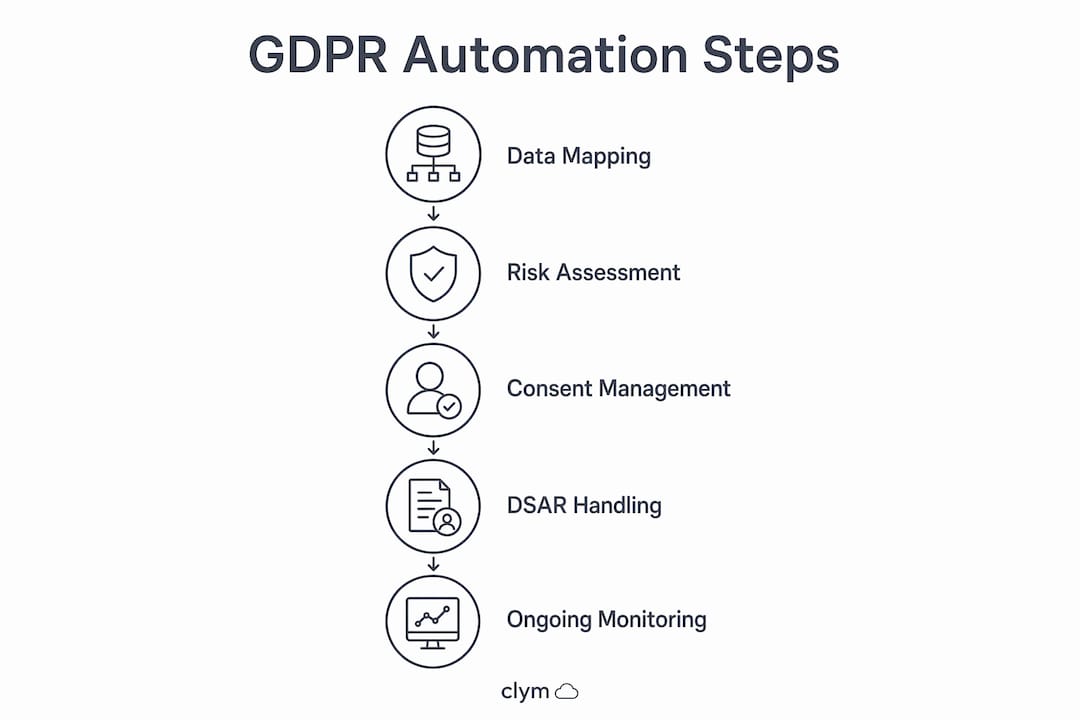
DSAR fulfillment is where manual processes fail most visibly. Under GDPR, data subject rights requests must be fulfilled within 30 days, and breach notifications must reach the relevant supervisory authority within 72 hours of identification. Software tracks both deadlines automatically, reducing the risk of a missed window that could trigger regulatory scrutiny.
Breach notification management creates a documented workflow from detection through notification, with timestamps that demonstrate the 72-hour requirement was met.
Cookie consent management operates at the front end of a website, blocking non-essential scripts until a visitor has given unambiguous consent. Consent records are logged with timestamps, banner version, and the specific choices made, creating an auditable trail.
Key compliance deadlines: GDPR requires data subject rights requests to be answered within 30 days and breach notifications to be filed within 72 hours of identification. Software tracking both timelines is not optional for organizations processing EU personal data at any scale.
GDPR compliance automation is an ongoing process, not a one-time configuration. Websites change constantly, and each plugin update or new third-party integration can invalidate a prior consent configuration.
Which privacy laws apply to US businesses, and how do they overlap?
GDPR applies based on whose data is processed, not where the business is located. Any US website that collects personal data from EU or UK residents is subject to GDPR, regardless of whether the company has a physical presence in Europe. This extraterritorial scope catches many US businesses off guard.
Several other frameworks create overlapping obligations:
- CCPA/CPRA (California): requires opt-out rights for data sales and sharing, privacy notices at collection, and defined response windows for consumer rights requests
- ePrivacy Directive: governs cookie placement and electronic communications in the EU, requiring prior consent for non-essential cookies
- LGPD (Brazil): Brazil’s data protection law mirrors GDPR in structure, with similar consent, rights, and breach notification requirements
- US state privacy laws: Virginia (VCDPA), Colorado (CPA), Connecticut (CTDPA), and others have enacted their own frameworks, each with distinct opt-out and consent requirements
The practical challenge for US SMEs is that these frameworks overlap but do not align perfectly. GDPR requires opt-in consent for cookies; CCPA/CPRA requires opt-out for data sales. A multi-regulation compliance approach needs software capable of presenting the correct consent mechanism to each visitor based on their location, not a single banner applied universally.
Without automation, businesses face manual tracking across multiple legal frameworks, inconsistent consent records, and no reliable mechanism for responding to rights requests within statutory deadlines.

Why scalable platforms with free tiers suit US SMEs
Most enterprise-grade privacy management suites are priced for large organizations with dedicated legal and compliance teams. US SMEs and independent website owners need a different model: one that covers the legal requirements without requiring a monthly subscription for each domain.
Passiro was built specifically to address this gap. Its founder, Bo Krogsgaard, encountered the problem directly while managing websites across multiple companies, each requiring its own consent setup. The result is a platform where the free cookie consent tier covers unlimited domains and unlimited traffic, permanently, with no page limits or expiry.
The technical foundation is substantive. Passiro is a registered IAB CMP (ID 499) with Google Consent Mode v2 integration, automatic script blocking, and a tracker database of 4,900+ entries sourced from EasyPrivacy and updated daily. Geo-targeted banners display the appropriate consent mechanism based on visitor location, a visual designer with templates and Google Fonts supports customization, and 25 languages cover international audiences. The platform is designed to support GDPR and ePrivacy compliance, CCPA/CPRA, LGPD, and US state privacy laws.
Two limitations are worth noting honestly. Passiro does not include automated DSAR fulfillment workflows, and it does not offer vendor risk management features. Organizations with significant DSAR volumes or complex processor relationships will need supplementary tooling for those functions.
Paid plans, priced in EUR, fund advanced features including consent analytics, white-label branding, and API access. That revenue sustains the free tier for all users.
Pro Tip: If you manage cookie consent across multiple client sites, Passiro’s unlimited-domain free tier eliminates the per-site subscription cost that makes agency-scale compliance prohibitively expensive with most alternatives.
How to evaluate pricing and deployment for cookie consent tools
Pricing structures across the GDPR compliance software market follow a few recognizable patterns. Free tiers typically cover basic consent banner functionality with limited customization or reporting. Subscription plans add automated scanning, analytics, and priority support. Usage-based models charge per domain, per page view, or per consent event.
Deployment considerations for US SMEs generally center on integration. Key factors include:
- Platform compatibility: WordPress, Wix, Squarespace, Webflow, Shopify, WooCommerce, and Magento each have distinct integration requirements. A solution with e-commerce platform support built in reduces implementation time considerably.
- User interface and customization: banner appearance affects consent rates; a visual designer that supports brand colors, fonts, and layout without requiring custom code is a practical advantage
- Language support: multi-language banners are necessary for any site with international traffic
- Security and data protection: look for encryption in transit and at rest, access controls, and documented data residency policies; ISO 27001 certification is a recognized benchmark for information security management
- Ongoing maintenance: GDPR compliance requires continuous monitoring as regulations evolve and website configurations change; automatic scanner updates and regulatory change alerts reduce the manual overhead of staying current
- Customer support and SLAs: for businesses without in-house privacy expertise, responsive support and documented service levels matter when a compliance question arises before a deadline
For website builders like Wix, Squarespace, and Webflow, native integration or a simple embed code is typically the most practical deployment path. Hosting providers may also offer consent management as part of their service stack, which can simplify setup for customers without technical resources. You can also review data sharing opt-out options as part of a broader privacy strategy for your visitors.
Passiro covers cookie consent from a single site to hundreds of domains
Cookie consent is a legal requirement under the ePrivacy Directive and GDPR. The tools to meet that requirement should not impose a recurring cost on every website that needs them.
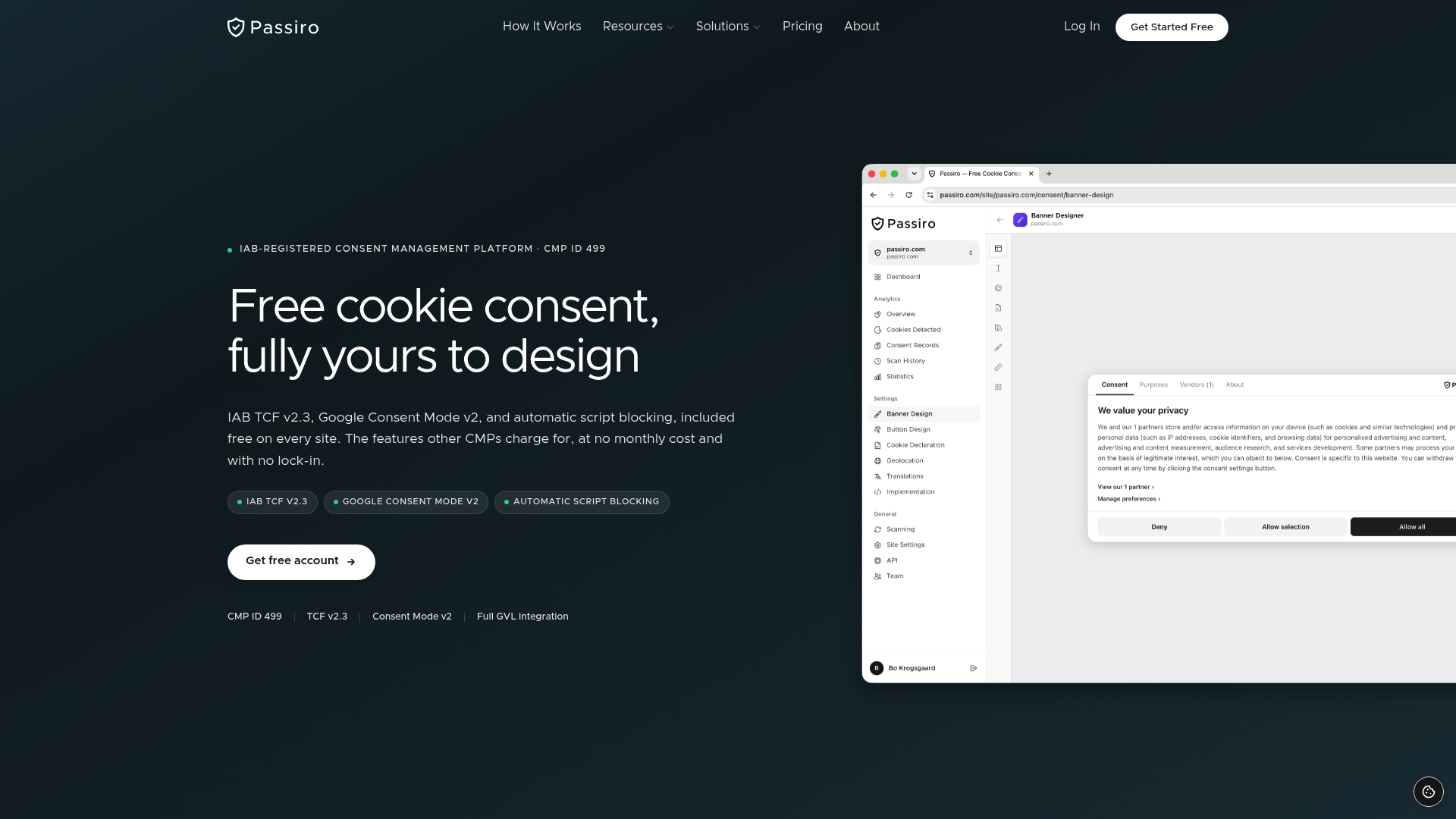
Passiro delivers a fully functional consent management platform at no cost, with no traffic caps and no domain limits. It is a registered IAB TCF v2.3 CMP (ID 499), not a basic popup, which means it generates a valid consent string recognized by advertising and analytics vendors. Google Consent Mode v2 is built in, automatic script blocking prevents non-consented trackers from firing, and geo-targeted banners present the legally appropriate mechanism to each visitor. For agencies managing dozens or hundreds of client sites, the same platform scales without per-site fees.
To get started, visit passiro.com and add your first domain for free.
Key Takeaways
GDPR compliance software automates the core privacy obligations that US website owners and SMEs must meet when processing EU personal data, with cookie consent management as the most immediate requirement for most sites.
| Point | Details |
|---|---|
| Statutory deadlines are fixed | GDPR requires DSAR responses within 30 days and breach notifications within 72 hours; software tracks both automatically. |
| Multi-law support is necessary | US sites serving EU visitors need tools covering GDPR, ePrivacy, CCPA/CPRA, LGPD, and US state laws simultaneously. |
| Ongoing monitoring is required | Website changes and plugin updates can invalidate prior consent configurations; automated scanning maintains continuous compliance. |
| Free tiers exist for SMEs | Platforms like Passiro offer unlimited domains and traffic at no cost, funded by paid plans for advanced features. |
| Passiro’s scope and limits | Passiro covers cookie consent, IAB TCF v2.3, Google Consent Mode v2, and geo-targeting; it does not include DSAR automation or vendor risk management. |
Recommended
Get compliant cookie consent — free
Passiro gives you a compliant cookie banner with IAB TCF v2.3 and Google Consent Mode v2, free on every site.