GDPR Compliant Software for Website Owners in 2026

For any website that collects personal data from visitors in the European Union or United Kingdom, GDPR compliant software is not optional. It is a legal obligation with financial consequences attached. The right tool manages cookie consent, blocks non-consented scripts, records user preferences, and transmits consent signals to advertising and analytics platforms — all before a single tracking cookie fires.
Passiro is the recommended solution for website owners and small to medium-sized businesses seeking practical, cost-effective support for GDPR and ePrivacy compliance. Built by founder and developer Bo Krogsgaard, it is a registered IAB Consent Management Provider (CMP ID 499) with full IAB TCF v2.3 and Google Consent Mode v2 integration. Its core capabilities include:
- Automatic script blocking until consent is obtained
- A tracker database of 4,900+ entries sourced from EasyPrivacy, updated daily
- Unlimited domains and unlimited traffic on the free tier
- A visual banner designer with templates, gradients, Google Fonts, and a stock photo library
- Support for 25 languages and geo-targeted consent banners
- Compliance infrastructure designed to support GDPR, ePrivacy, CCPA, and LGPD
Two genuine limitations apply: Passiro does not currently offer data subject access request (DSAR) automation, and it does not include a vendor risk management module. Businesses requiring those capabilities will need supplementary tools.
Table of Contents
- Why GDPR compliance matters for US businesses
- What to look for in GDPR compliant cookie consent software
- Passiro: a practical GDPR compliant cookie consent tool
- How to implement GDPR cookie consent on your website
- Common challenges when implementing GDPR compliant software
- Passiro is free for every website, permanently
- Key Takeaways
Why GDPR compliance matters for US businesses
GDPR’s extraterritorial reach is one of the most consistently misunderstood aspects of the regulation. It applies to any organization processing the personal data of individuals located in the EU or UK, regardless of where that organization is headquartered. A US-based e-commerce store, SaaS product, or content publisher with European visitors is subject to GDPR obligations the moment it collects personal data from those visitors.
The financial exposure is substantial. Under Article 83 of the GDPR, penalties for serious violations can be as high as 4% of a company’s total global annual turnover of the preceding financial year. Supervisory authorities across the EU have demonstrated a clear willingness to pursue enforcement actions against non-EU companies.
Beyond financial penalties, the reputational damage from a publicized GDPR breach can erode customer trust in ways that outlast any regulatory fine. Many US businesses underestimate this exposure, particularly when it comes to cookie consent. Placing analytics or advertising trackers on a website without a lawful basis and a properly structured consent mechanism is a direct violation of both the GDPR and the ePrivacy Directive.
What to look for in GDPR compliant cookie consent software
Selecting the right data protection software requires evaluating several functional criteria, not just price. The following capabilities represent the baseline for any credible consent management solution:
- IAB TCF v2.3 registration: The Interactive Advertising Bureau’s Transparency and Consent Framework is the industry standard for communicating consent signals to advertising vendors. Software that is a registered CMP under TCF v2.3 provides a verifiable, structured consent string rather than a simple preference cookie.
- Google Consent Mode v2 integration: This transmits consent signals directly to Google’s advertising and analytics platforms, allowing those services to adjust their behavior based on user choices. Without it, Google Ads and Google Analytics may operate outside the user’s stated preferences.
- Automatic script blocking: Third-party scripts should not execute until the user has provided consent. Software that enforces this at the technical level removes the risk of inadvertent data collection before consent is recorded.
- Geo-targeted banners: Visitors from different jurisdictions have different legal entitlements. A visitor from California has rights under the CCPA; a visitor from Germany has rights under the GDPR. Displaying region-appropriate notices is a practical requirement for globally accessible websites.
- Consent logging and audit records: Maintaining a verifiable record of when, how, and for what purposes consent was given is a core accountability obligation under GDPR. This documentation supports audit readiness and regulatory inquiries.
- Multi-language support: Consent notices must be presented in a language the user understands. Software limited to one or two languages creates compliance gaps for multilingual audiences.
- Accessible pricing for SMBs: Enterprise-tier pricing structures are not appropriate for small businesses managing one or a handful of websites. A free tier with genuine functionality, not a restricted trial, is the standard that responsible vendors should meet.
Integrating privacy policy practices into the broader software development and deployment lifecycle strengthens the overall compliance posture beyond the consent banner itself.
Passiro: a practical GDPR compliant cookie consent tool
Passiro was built to address a specific gap: the absence of a genuinely free, technically rigorous consent management platform for website owners who cannot justify enterprise subscription costs for a lightweight JavaScript widget. Bo Krogsgaard, the founder and developer, built every component himself, including the IAB TCF v2.3 CMP, Google Consent Mode v2 integration, automatic script blocking, and the underlying infrastructure.
Key capabilities:
- Registered IAB CMP (ID 499), generating a structured TCF consent string, not a simple preference flag
- Google Consent Mode v2 integration, transmitting consent signals to advertising and analytics platforms
- Automatic script blocking, preventing third-party trackers from loading before consent is recorded
- 4,900+ tracker database sourced from EasyPrivacy, updated daily, with per-vendor consent tied to the IAB Global Vendor List
- Visual banner designer with templates, gradients, stock photos, and Google Fonts
- 25 languages supported, with geo-targeted banners displaying region-appropriate notices
- Free tier covering unlimited domains and unlimited traffic, with no expiry and no page limits
- Pricing in EUR for paid plans, which add consent analytics, white-labeling, and API access
Transparent limitations: Passiro does not include DSAR automation, so businesses managing high volumes of data subject access requests will need a separate workflow. It also lacks a vendor risk management module, which larger organizations subject to Article 28 processor obligations may require.
Pro Tip: If you manage multiple client websites as an agency, Passiro’s free tier covers unlimited domains from a single account. That removes the per-domain subscription cost that makes most consent platforms impractical at scale.
How to implement GDPR cookie consent on your website
- Create a free Passiro account. No credit card is required. Connect your domain through the guided setup interface.
- Configure your banner using the visual designer. Select a template, apply your brand colors and fonts, and set the consent categories relevant to your site’s tracking activities.
- Activate geo-targeting. Set region-specific rules so that visitors from the EU see a GDPR-compliant notice, US visitors from applicable states see a CCPA-appropriate banner, and so on.
- Enable automatic script blocking. This prevents any third-party scripts from executing until the user has made a consent choice, removing the risk of pre-consent data collection.
- Install the consent snippet on your website. For WordPress sites, Passiro provides a dedicated plugin. For Wix, Squarespace, Webflow, and other website builders, the JavaScript snippet installs via the platform’s custom code settings.
- Review consent records in the dashboard. Passiro logs consent events, providing the audit trail necessary to demonstrate accountability under GDPR.
- Run periodic audits. Use Passiro’s cookie compliance checklist and GDPR compliance tester to verify that your implementation remains current as your site’s third-party integrations change.
Common challenges when implementing GDPR compliant software
Underestimating the scope of script blocking. Many website owners assume that adding a consent banner is sufficient. It is not. If third-party scripts load before consent is recorded, the banner is decorative rather than functional. Automatic script blocking at the technical level is the only reliable safeguard.

Treating consent as a one-time setup. Websites change. New analytics tools, advertising pixels, and embedded content are added regularly, often without a corresponding review of the consent configuration. Each new third-party integration introduces a potential compliance gap if it is not added to the consent framework.
Using non-standard consent strings. A cookie that stores a “yes/no” preference is not a TCF-compliant consent record. Advertising platforms and regulators expect a structured consent string generated by a registered CMP. Software that does not produce one may satisfy the visual requirement of a banner while failing the technical requirement of lawful consent.
Neglecting multi-jurisdiction requirements. A website accessible globally may be subject to GDPR, the ePrivacy Directive, CCPA, and LGPD simultaneously. Displaying a single banner without geo-targeting creates a mismatch between the legal obligations applicable to each visitor and the notice they actually receive.
Failing to maintain consent logs. Without a verifiable record of consent events, a business cannot demonstrate accountability to a supervisory authority. Consent logging is not an optional feature; it is a legal requirement under GDPR’s accountability principle.
Passiro is free for every website, permanently
Cookie consent is a legal requirement. The infrastructure to manage it should not carry a monthly subscription fee that exceeds the cost of web hosting itself.
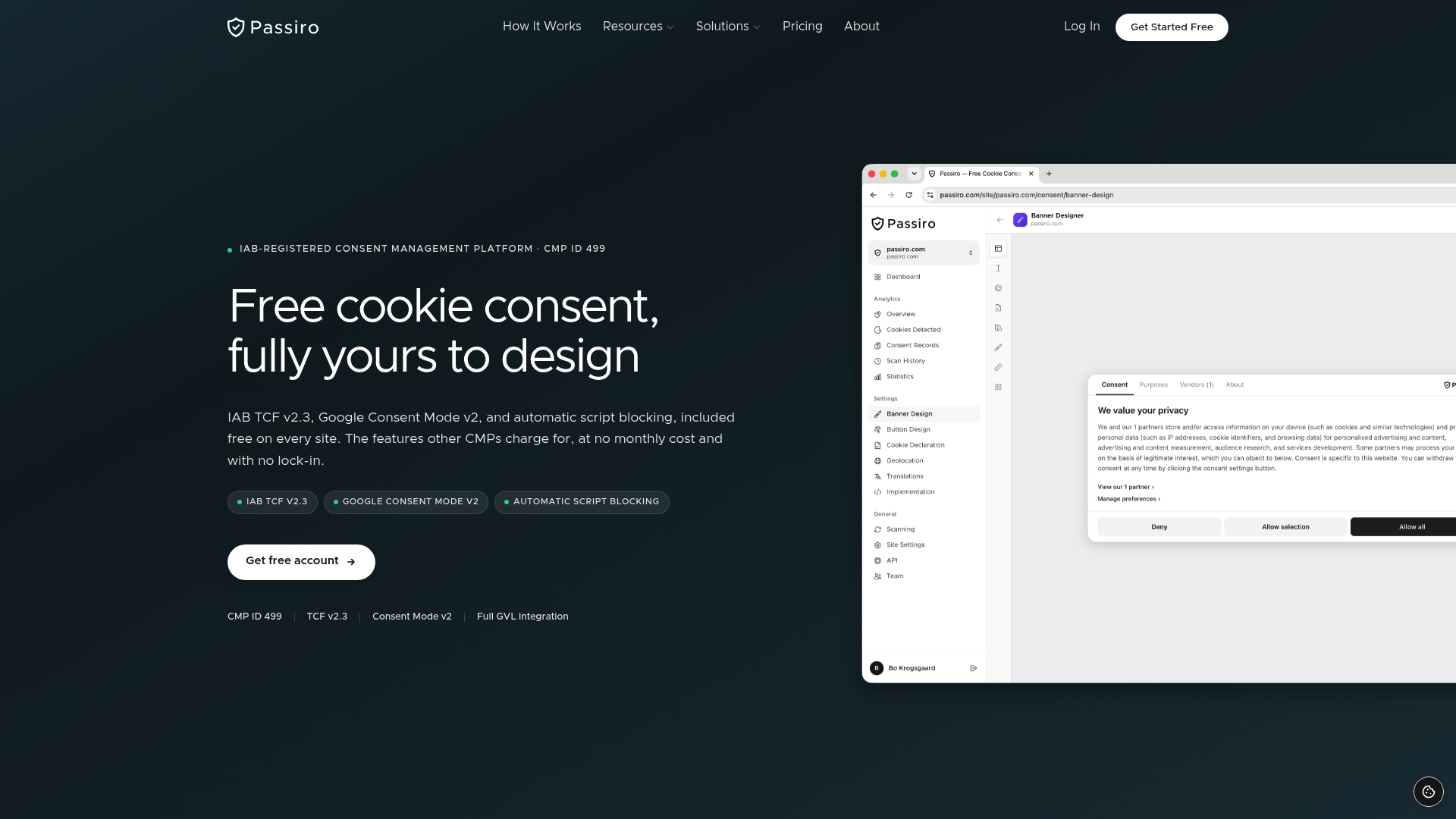
Passiro provides a fully functional consent management platform at no cost, with no traffic caps, no domain limits, and no expiry. It is a registered IAB CMP (ID 499) with Google Consent Mode v2 integration, automatic script blocking, and a daily-updated tracker database — the technical foundation that GDPR-compliant cookie consent actually requires. For website owners running WordPress, the free WordPress cookie consent plugin installs in minutes. For Wix, Squarespace, and Webflow sites, Passiro’s website builder solution covers the same functionality without code. Paid plans in EUR are available for agencies and businesses that need consent analytics, white-labeling, or API access, and that revenue funds the free tier for everyone else.
Key Takeaways
GDPR applies to any US business processing EU or UK personal data, and penalties under Article 83 can be substantial, calculated as a percentage of global annual turnover.
| Point | Details |
|---|---|
| GDPR applies to US businesses | Any organization processing EU or UK personal data is subject to GDPR, regardless of where it is based. |
| Penalties reach up to 4% of global annual turnover | Article 83 of the GDPR sets maximum fines at 4% of a company’s total global annual turnover of the preceding financial year. |
| Script blocking is non-negotiable | Third-party trackers must be blocked at the technical level until consent is recorded, not just visually gated. |
| Consent logs support accountability | Maintaining verifiable records of consent events is a legal requirement under GDPR’s accountability principle. |
| Passiro offers a free tier | Passiro covers unlimited domains and unlimited traffic at no cost, with IAB TCF v2.3 and Google Consent Mode v2 included. |
Recommended
Get compliant cookie consent — free
Passiro gives you a compliant cookie banner with IAB TCF v2.3 and Google Consent Mode v2, free on every site.