Top 6 CookieYes Alternatives for 2026

Managing cookie consent for GDPR, ePrivacy, and US privacy laws is growing more complex across multiple domains and regulations. Many platforms lock core compliance features behind high-fee tiers or limit automation and customization on their free plans, which forces upgrades for basic needs. This comparison details pricing, automation, and language support so agencies and website owners can select a consent tool that fits their legal and operational requirements.
Table of Contents
Passiro
At a Glance
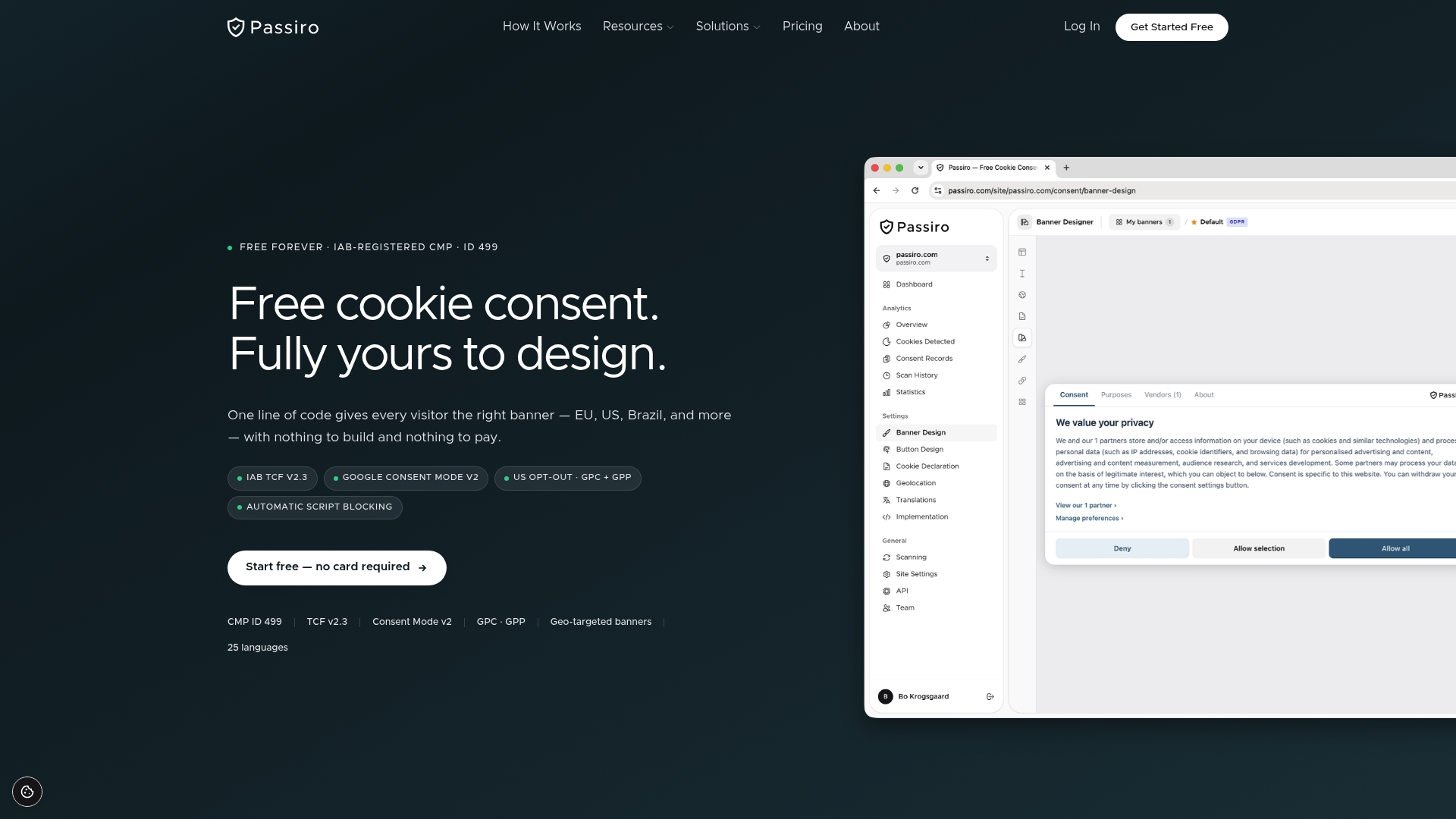
Full GDPR, ePrivacy, and US privacy law compliance is available entirely free with no limits on pages or traffic. The platform supports IAB TCF v2.3 and Google Consent Mode v2, and it performs automatic script blocking before consent. Geo targeted banners ship in 25 languages and deploy with a single embed across WordPress, eCommerce platforms, builders, and hosting environments.
Core Features
The product implements IAB TCF v2.3, Google Consent Mode v2, and automatic script blocking to prevent trackers from loading before consent. Deployment uses a single line of embed code so teams can push consistent banners across many client sites, while a visual editor allows banner customization of colors, images, and fonts on the free plan. Geo targeting and language support cover regional legal text and display rules.
Key Differentiator
Full compliance across GDPR, ePrivacy, and US privacy laws appears on the free tier with no page or traffic limits, which reduces license overhead for agencies and hosts. That unlimited allowance, paired with global edge delivery, keeps consent banners fast and regionally accurate. The approach shifts cost from licensing to configuration and hosting.
Pros
Free forever access delivers core compliance features without licensing fees, which helps agencies and small businesses avoid per domain costs. A single line embed code makes rollout predictable and repeatable across WordPress, eCommerce, and hosting panels. Built in script blocking and standards support help meet ad tech requirements for publishers running Google Ads and TCF reliant stacks.
Cons
- Advanced automation and customization features require paid plans.
Who It’s For
Passiro is built for small and medium sized businesses, agencies, and website owners who need compliant cookie consent without enterprise pricing or complexity. Hosting providers that want a bundled consent option and agencies managing many client domains will find the unlimited pages and language coverage useful. E commerce stores that require TCF support for ad platforms also fit this profile.
Unique Value Proposition
No limits on pages or traffic combined with the single line embed reduces both setup time and license cost for agencies and hosting partners managing multiple domains. That model lets one dashboard cover many client sites while maintaining measurement via Google Consent Mode v2 and TCF compatibility. Free tier customization and language options let teams avoid immediate upgrade costs for standard banner needs.
Real World Use Case
A digital marketing agency deploys the embed across 50 client sites and uses one dashboard to manage regional banner text, consent logs, and script blocking rules. The agency configures TCF purposes for Google Ads and leaves tracking blocked until consent is given. Multilingual banners display localized notices for EU markets and Brazil without separate codebases.
Pricing
The core consent platform is free forever for unlimited pages and traffic. Paid plans start at €9/month and add features such as branding removal, automated scans, API access, and prioritized support.
Website: https://passiro.com
Termly
At a Glance
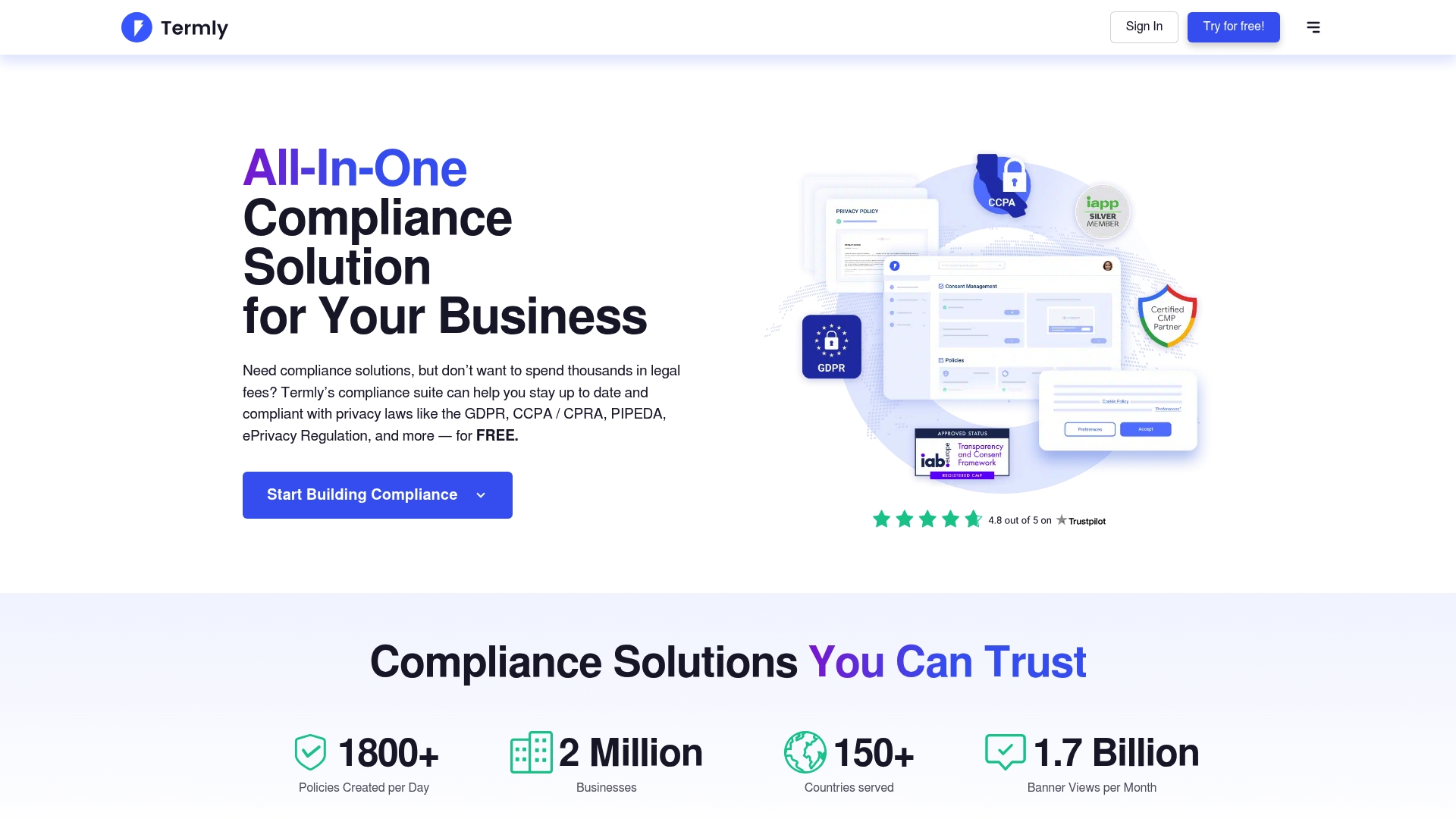
Termly reports trust from over 2 million businesses worldwide. It combines legal policy generators, cookie scanning, and a consent preference center in one platform. The product offers a free basic tier alongside paid plans that scale to paid sites and bulk licensing.
Core Features
Termly provides generators for Privacy Policy, Terms and Conditions, Cookie Policy, EULA, and other legal pages, and those templates are described as attorney crafted. The consent management module includes a preference center and cookie scanner that identifies tracking mechanisms. The platform also supports Google Consent Mode and IAB TCF 2.3, and it installs via copy and paste snippets for most sites.
Key Differentiator
The main distinction is Termly’s all in one compliance approach with automatic policy updates and broad international law coverage. That focus reduces the manual work of keeping legal pages current across jurisdictions. The combination of policy generators plus scanner and consent controls positions it as a single vendor for policy drafting and consent enforcement.
Pros
A free basic plan exists, which helps small sites publish a legal policy without upfront cost. Attorney crafted templates simplify policy language and reduce the need for immediate legal counsel. Automatic updates and multi jurisdiction support keep policies current as laws change, and the cookie scanner plus consent center work together to centralize compliance tasks.
Cons
- Basic features are limited on the free plan, for example only one legal policy is available.
- Several advanced capabilities require a paid plan, which raises costs for larger sites.
- Large multi site organizations may need manual configuration for complex setups.
When It May Not Fit
Organizations that run dozens of domains and require automated multi site deployment tools will find manual setup burdensome. Enterprises needing deep vendor risk management or DSAR automation should look elsewhere. Sites that expect all advanced features on the free tier will need to budget for paid plans.
Who It’s For
Small and medium sized businesses, website owners, and compliance professionals who want an affordable, single platform for core privacy tasks. Teams that need rapid policy generation and basic consent controls without hiring outside counsel will find it practical. Businesses expanding to multiple jurisdictions benefit from the international law coverage.
Real World Use Case
A small e commerce site used Termly to generate a privacy policy and add a consent banner before a launch. The cookie scanner found trackers and the preference center captured granular consent choices. The owner avoided hiring a lawyer and kept policies updated as GDPR and CCPA guidance evolved.
Pricing
Termly offers a free basic tier for core features. Paid plans start at $10 per website/month, with discounts available for annual billing and bulk licenses. Exact feature gates vary by plan level and billing cadence.
Website: https://termly.io
Cookiebot
At a Glance
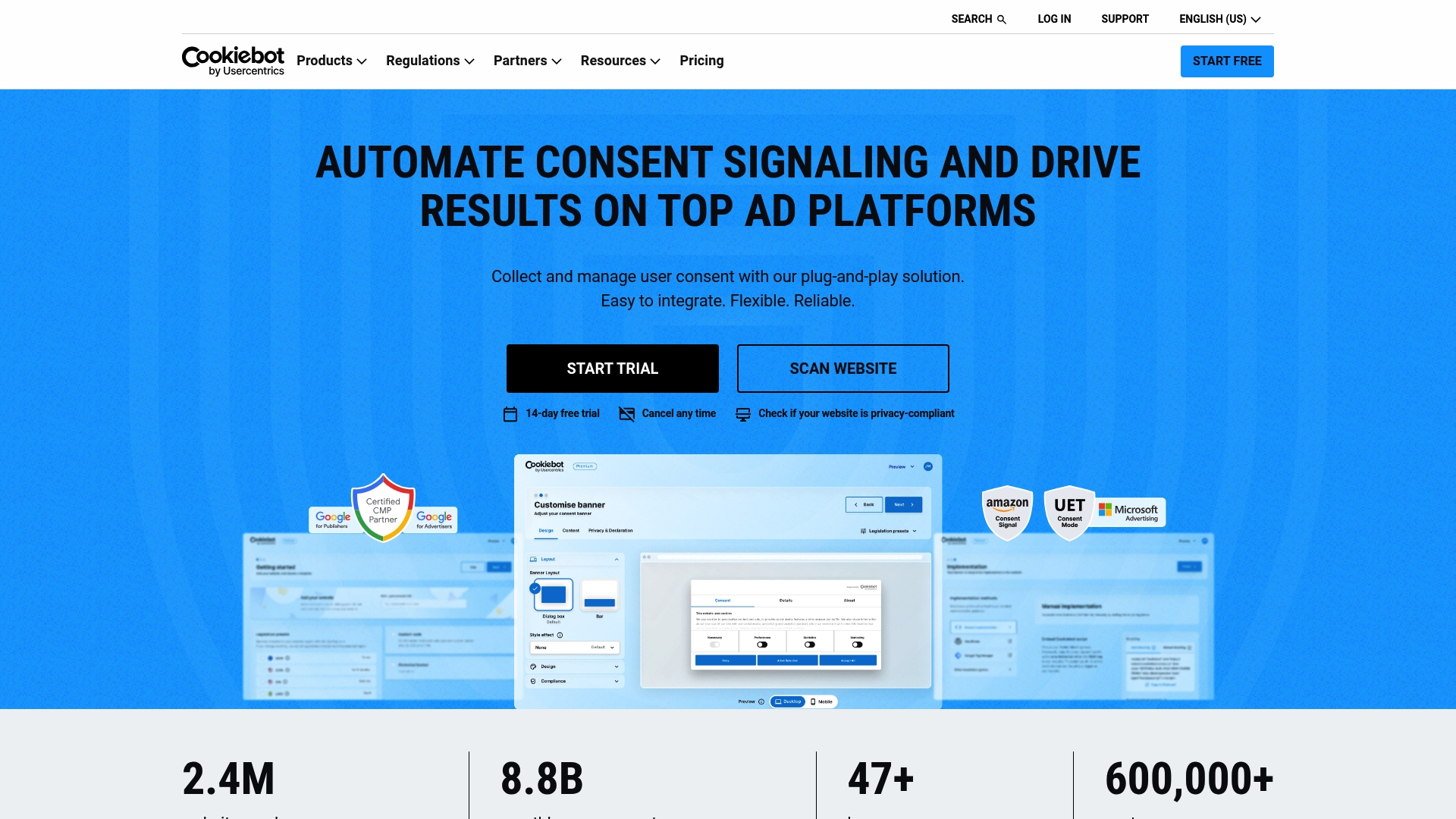
Performs automated scanning and classification of cookies and trackers across an entire site. According to the company, Cookiebot holds ISO 27001 and is HIPAA ready. The service presents configurable consent banners and multi language support for region specific privacy rules.
Core Features
Cookiebot combines site wide cookie discovery with categorization and consent recording, and it pairs that with configurable cookie consent banners for site visitors. The platform supports region specific compliance for GDPR, CCPA, and LGPD while offering integrations with common CMS platforms such as WordPress, Shopify, and Wix. Cookiebot also reports consent percentages and provides analytics for consent trends.
Key Differentiator
Cookiebot’s standout claim is its advanced automation that scans, classifies, and updates cookie policies dynamically across multiple regulations. That level of automation reduces manual tagging work for multisite deployments and centralizes consent reporting. The approach suits organizations that must manage privacy settings across many domains.
Pros
Set up is straightforward for standard sites, and the banner templates accelerate deployment for common content management systems. The product automates policy updates and consent tracking, which reduces ongoing manual maintenance for regional rules. Security claims and certification references support privacy controls, and Cookiebot provides detailed analytics and multi region support for consent reporting.
Cons
- Limited flexibility for highly complex websites when custom cookie behavior is required.
- Initial configuration can be challenging without developer support, according to third party reviews.
- Pricing is not publicly disclosed, which makes cost planning harder for agencies managing many domains.
When It May Not Fit
Sites that require bespoke banner designs or custom consent flows may find the template options restrictive. Agencies that build highly tailored consent experiences for enterprise clients will need deeper customization than Cookiebot’s standard controls offer. Teams that require transparent, published pricing for budgeting across many sites may prefer an alternative with clear tiered rates.
Who It’s For
Businesses that need automated cookie compliance across multiple regions and want a turn key discovery and consent workflow. Organizations running multiple domains or multilingual sites benefit from centralized scanning and consent reporting. Digital teams that can allocate developer time for complex setups will get the most value.
Real World Use Case
A multinational e commerce company uses Cookiebot to run daily scans across its storefronts, label cookies into required categories, and present consent banners in each visitor’s language. The marketing operations team reviews consent percentage reports to measure banner performance across regions. Legal receives consolidated logs for GDPR and CCPA documentation.
Website: https://cookiebot.com
CookieHub CMP
At a Glance
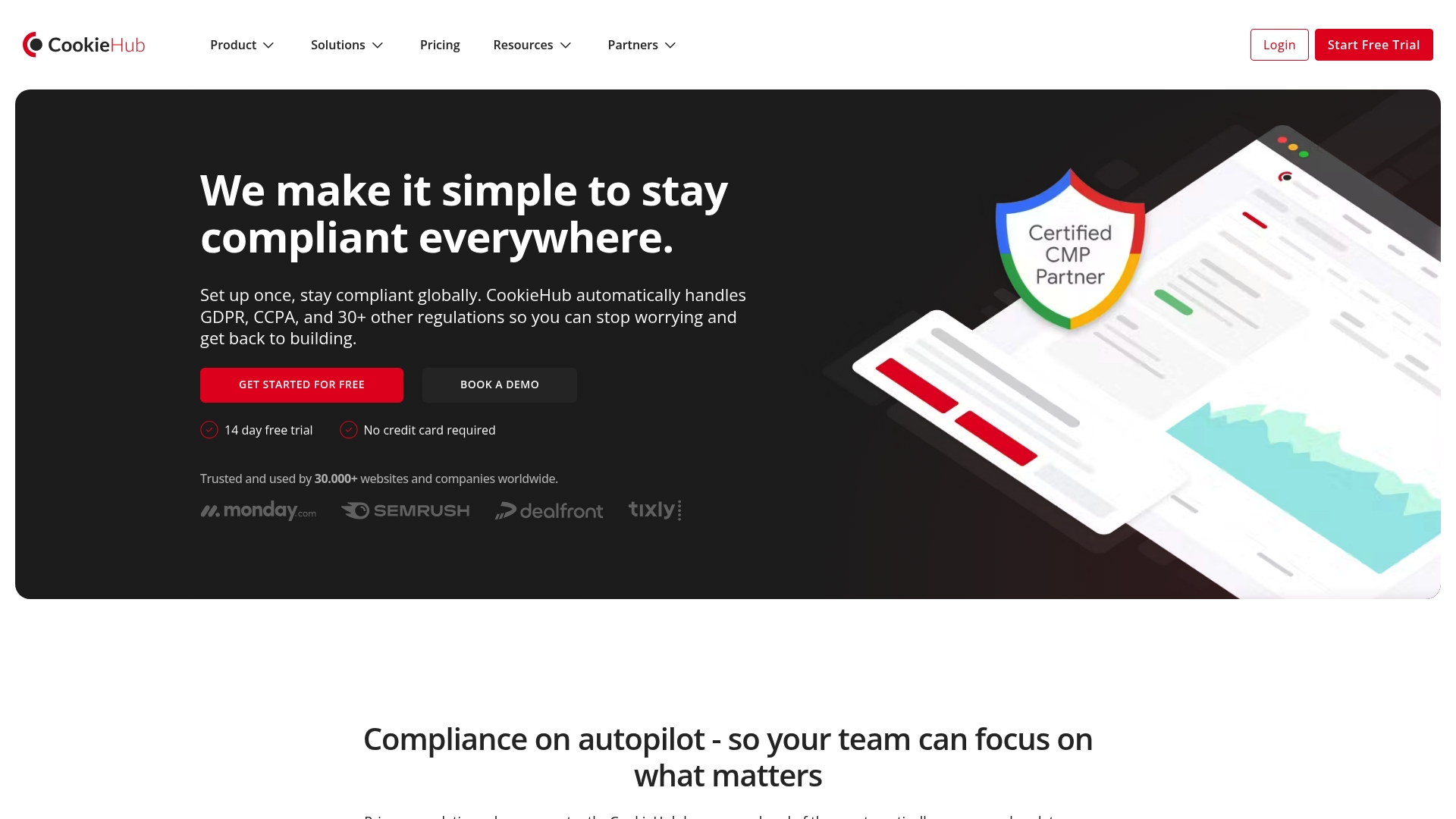
CookieHub CMP reports being used by more than 30,000 websites worldwide. It automates cookie blocking, geo targeting, consent logging, and regional banners. The platform offers DSAR management and SSO for enterprise customers.
Core Features
Automated cookie scanning pairs with automatic cookie blocking to stop nonconsented tags before they fire. Regional controls support GDPR, CCPA, LGPD, PIPL, and Google Consent Mode v2 along with IAB TCF 2.3. Adaptive banners, proof of consent logs, and audit reporting complete the core capabilities.
Key Differentiator
The vendor advertises Google certification and positions the product as a fully automated compliance tool across regions. That claim, combined with multi framework support, simplifies cross border consent for sites with mixed audiences. CookieHub targets minimal manual intervention for ongoing compliance. That automation reduces manual rule updates for sites operating in several jurisdictions.
Pros
Implementation requires little developer time. Templates and CMS plugins let marketing teams deploy banners quickly. Custom branding and multi language options let sites match visual guidelines and localize consent text. Integrations with WordPress, Shopify, Wix, Webflow, Magento, and tag managers ease tag control and reporting. DSAR tools and SSO support help larger organizations centralize records and access while proof of consent preserves audit trails.
Cons
- Pricing scales with session volume and feature sets. That model can become costly for very high traffic sites.
- Advanced configuration and rule logic require technical knowledge or vendor onboarding for correct setup.
- The marketing overview leaves some advanced capabilities unspecified. Buyers should confirm details during trial or demo.
When It May Not Fit
Sites with extremely high session volumes may face steep costs as pricing scales by sessions. Teams without in house technical support should budget for onboarding or consultancy when complex rules are required. Organizations needing full public documentation of every advanced feature should validate capabilities before purchase. If buyers need turnkey reporting templates for regulators, confirm the available reports during trial.
Notable Integrations
Key integrations cover major CMS and tag managers. Supported platforms include Google Tag Manager, WordPress, Shopify, Wix, Magento, Webflow, and Matomo Tag Manager. These connections simplify tag control and consent synchronized firing across ecosystems.
Who It’s For
Mid sized to large websites, publishers, and agencies managing compliance across multiple regions will find the feature set relevant. Compliance officers who need DSAR workflows and SSO support will benefit from the enterprise tools. Ecommerce platforms with multiple regional storefronts gain from geo targeting and localized banners.
Real World Use Case
A global ecommerce retailer implemented CookieHub to handle GDPR in Europe, CCPA in California, and LGPD in Brazil from one control panel. The team automated cookie detection, deployed localized banners, and logged consent records for audits. That setup reduced manual compliance tasks and centralized consent reporting for legal and marketing teams.
Pricing
Pricing starts at €6/month for basic plans, with a free tier for sites under 1,000 sessions per month. Costs rise with session volume and advanced feature sets. Buyers with high traffic should forecast monthly sessions to estimate fees and test the trial.
Website: https://cookiehub.com
Cookie Information
At a Glance
The vendor claims its anonymous tracking can recover up to 4 times more web analytics data from visitors who decline cookies. The platform advertises cookie scanning, consent record keeping, and Google Consent Mode v2 support. That combination targets teams that need analytics recovery with consent-aware controls.
Core Features
According to the company, Cookie Information is EU-hosted, reports GDPR and CCPA compliance, and the vendor states it is trusted by over 5,000 organizations. Automatic cookie scanning and real-time classification reduce manual audits while full banner templates support multiple languages and visual customization. Integrations with common CMS and tag managers plus anonymous tracking aim to preserve aggregate insight when users refuse traditional cookies.
Key Differentiator
The standout capability is anonymous tracking. That recovery claim positions Cookie Information for teams that must balance consent boundaries with usable analytics. The feature focuses on aggregate, privacy-preserving metrics rather than individual profiling.
Pros
Highly customizable cookie banners with multi-language support let marketers and legal teams present precise consent choices without code changes. Automatic scans and live classification cut the time needed to inventory trackers, and the platform integrates with WordPress, Drupal, Google Tag Manager, and common ad systems for faster deployment. The anonymous tracking feature aims to recover analytics lost to non-consent, and deployment options include plugins and copy-paste snippets that remove developer dependencies.
Cons
-
Pricing is tiered by domain and actions, which can make costs material for very small organizations or those with many sites.
-
Maintaining ongoing compliance requires active configuration and monitoring as laws and vendor scripts change.
-
Some users report the interface has a learning curve and that support or training may be needed for full use.
When It May Not Fit
Organizations with very small budgets or a single simple site may find the tiered pricing heavier than necessary. Teams that lack capacity to monitor consent settings and third-party scripts will need extra staff or a retained consultant. Projects that require turnkey, zero-configuration setups may find the interface and rule sets more complex than desired.
Notable Integrations
WordPress, Drupal, Google Tag Manager, Piwik PRO, and ad platforms are listed as integrations. These connections support common CMS workflows and tag management scenarios. Use the WordPress plugin for fast deployment on many sites.
Who It’s For
Organizations that need a GDPR-focused consent manager and want to recover usable analytics while keeping privacy boundaries. Legal and marketing teams that run multiple domains and require language support will benefit most. Agencies that manage client estates across Europe will find the scanning and integration options relevant.
Real World Use Case
A European retail chain uses Cookie Information to meet regional consent rules while maintaining marketing insight. The retailer ran automatic cookie scans, deployed localized banners, and used anonymous tracking to preserve aggregate analytics for campaign optimization.
Pricing
From €19/month per domain for the Essential plan. From €35/month for the Business plan. Custom enterprise solutions are available for larger deployments.
Website: https://cookieinformation.com
CookieFirst
At a Glance
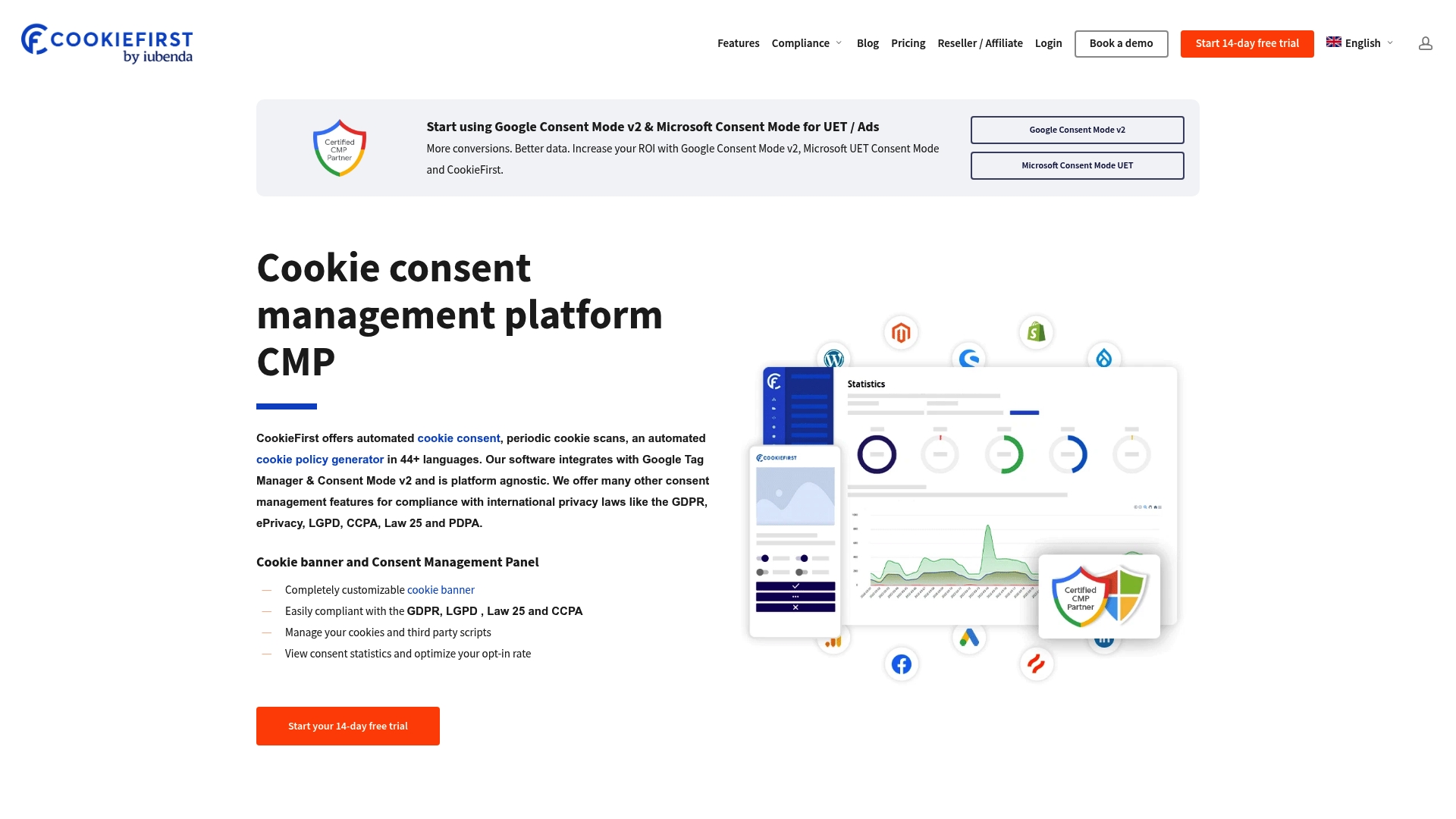
A cookie policy generator in 44+ languages is available. The vendor advertises support for GDPR, ePrivacy, LGPD, CCPA, Law 25, and PDPA compliance. CookieFirst also reports platform agnostic operation with Google Tag Manager and Consent Mode v2 integrations and a free trial for evaluation.
Core Features
CookieFirst performs automated cookie consent management and periodic cookie scans with reports. The product includes a cookie policy generator in more than 44 languages and customizable cookie banners and consent panels. It also supports granular opt-in control for cookies and third-party scripts, plus compliance audit tools for multi-region sites.
Key Differentiator
Platform agnostic support combined with direct integration into Google Consent Mode v2 and Google Tag Manager sets CookieFirst apart. That combination makes it practical for sites that already use GTM and need language coverage for multiple regions.
Pros
Setup and customization are straightforward, and the interface supports multiple privacy laws and languages. The platform integrates with Google Tag Manager and Consent Mode v2, which simplifies tag behavior based on consent signals. A free trial and reseller plans make it accessible for agencies and small teams evaluating compliance tooling.
Cons
- Limited features on the free plan require upgrading for cookie statistics and whitelabel options.
- Large-scale implementations can become complex and may need additional configuration and manual oversight.
- Enterprise deployments require custom setup and quotes, which adds onboarding time.
When It May Not Fit
Organizations that need full-featured analytics on a free plan will find the free tier restrictive. Enterprises seeking turnkey, white-labelled deployment without vendor setup will need the custom enterprise option. Sites without dedicated developer resources should plan for implementation effort and ongoing maintenance.
Notable Integrations
CookieFirst integrates with Google Tag Manager and Google Consent Mode v2. These connections allow tags to respond to consent states and help gate third-party scripts. The integrations suit teams that route analytics and marketing tags through GTM.
Who It’s For
Webmasters, digital marketers, and compliance officers at small and mid-sized sites looking for multilingual consent controls will benefit. Agencies that manage multiple client domains can use reseller plans and the multi-language policy generator. Developers who already use Google Tag Manager will find the integration useful.
Real World Use Case
A mid-sized e-commerce site used CookieFirst to deploy a multilingual cookie banner and policy pages. The team wired consent signals into Google Tag Manager and applied Consent Mode v2 to pause advertising tags until consent was granted. The implementation reduced manual tag blocking and centralized consent management across languages.
Pricing
CookieFirst lists a free tier and two paid plans: Basic €9/month and Plus €19/month, with enterprise pricing available on request. The vendor notes feature limits on the free plan and custom setup for enterprise customers. Prospective buyers should verify which features the selected tier includes.
Website: https://cookiefirst.com
Comparison of Alternatives
Passiro’s free tier stands out in the landscape of cookie consent management tools, offering features such as support for GDPR and US privacy laws paired with unlimited pages and traffic, by competitors. However, other platforms in this comparison shine in areas such as policy generation and advanced automation.
Free and Scalable Setup
Passiro allows unlimited usage on its free tier without restrictions on page views or traffic, which is ideal for agencies managing multiple client websites. This capability sharply contrasts with competitors’ scaled pricing structures, particularly CookieHub CMP, whose costs increase based on session volumes. Termly and CookieFirst provide free plans as well, but their feature sets are notably narrower, with limitations on policy coverage and banner customization.
Automated Policy Generation
Termly excels here by offering attorney-drafted legal policy templates alongside cookie scanning and a consent preference center. This integrated approach reduces the necessity of consulting external legal services for basic compliance documentation. Cookiebot and CookieHub CMP also provide automation tools for identifying cookies and deploying banners, though Termly’s emphasis on legal language elevates its value to teams seeking policy solutions.
Best Fit
- Small agencies or hosting providers managing multiple domains will benefit most from Passiro’s free tier, allowing widespread deployment without licensing costs.
- Businesses needing integrated policy generation may prefer Termly for the inclusion of legal templates tailored to regulations.
- Sites requiring advanced banner customization may find CookieHub CMP’s design and localization tools more appropriate.
- Teams prioritizing aggregate analytics might choose Cookie Information for its anonymous tracking features that recover metrics from users refusing cookies.
Our Pick
Passiro emerges as the choice for cost-conscious teams managing extensive client portfolios or domains due to its unlimited free tier, straightforward deployment via embed code, and compliance with multiple regional legal frameworks. However, teams prioritizing advanced automation or legal policy drafting may find other options better suited to their needs.
Passiro offers robust GDPR and ePrivacy compliance implementation with scalable features and no page or traffic limits, making it suitable for agencies and businesses managing multiple domains efficiently.
| Platform | Key Strength | Ideal For | Pricing | Limitation |
|---|---|---|---|---|
| Passiro | GDPR and ePrivacy support on free tier | Agencies, multiple domain owners | Free core features | Advanced automation requires paid plans |
| Termly | All-in-one compliance tools | Small sites needing quick policies | $10/site/month | Limited free features for growing needs |
| Cookiebot | Advanced automation for tracker analysis | Multisite organizations | Price not published | Initial setup may require developer support |
| CookieHub CMP | Automated controls across multiple laws | Enterprises with high compliance needs | €6/month starter | Higher pricing for high-session sites |
| Cookie Information | Anonymous tracking for consent-aware analytics | Privacy-conscious marketers | From €19/month | Complex UI may require training |
| CookieFirst | Platform-agnostic multilingual policy generation | Mid-sized multilingual sites | €9/month | Limited features in free tier |
Challenges When Searching for CookieYes Alternatives for 2026
Selecting cookie consent solutions that support GDPR, CCPA, and LGPD while avoiding enterprise pricing can be difficult for small and medium sized businesses, agencies, and website owners. Many options limit traffic or domains or require complicated multi-site configuration. Passiro addresses these challenges by offering support for IAB TCF v2.3 and Google Consent Mode v2 with automatic script blocking and geo targeted banners in 25 languages. Its free tier allows unlimited pages and traffic, simplifying deployment across many client domains or a single WordPress site.
For those seeking alternatives with scalability and compliance focus, Passiro helps reduce licence overhead and standardize consent management in one dashboard. Visit Passiro to learn how you can configure regional banner text, apply consent logs, and manage script blocking rules across your websites. See how Passiro supports your needs without immediate upgrade costs and lets you manage consent management easily from a unified platform.
Passiro offers a clear path to support privacy regulations worldwide while keeping setup predictable and customizable.
FAQ
How does Passiro support GDPR and ePrivacy compliance for businesses?
Passiro is designed to support GDPR and ePrivacy compliance by implementing IAB TCF v2.3, automatic script blocking, and providing geo-targeted banners. It offers a comprehensive solution with a free tier that includes unlimited domains and traffic, allowing businesses to manage consent effectively. Teams looking to ensure compliance should consider utilizing Passiro’s features to streamline their processes.
What is the difference between Termly and Passiro in terms of policy generation?
Termly provides a robust set of legal policy generators, including Privacy Policy and Terms and Conditions, which are crafted by attorneys. Passiro, on the other hand, focuses on automatic script blocking and traffic management, making it suitable for those prioritizing extensive consent management features without needing detailed legal templates. Businesses should assess which capabilities align best with their needs.
Can I integrate Passiro into my existing CMS easily?
Yes, Passiro installs via a single line of embed code, allowing easy integration with various CMS platforms, including WordPress and eCommerce solutions. This straightforward implementation means teams can deploy consent banners quickly while managing compliance across multiple client sites. Organizations with existing CMS setups will find this integration beneficial for maintaining efficiency.
What unique features does Passiro offer compared to Cookiebot?
Cookiebot excels in its advanced automation for cookie scans and classification across multiple regulations, while Passiro differentiates itself with a free tier featuring unlimited domains and traffic. Businesses that require extensive tracking capabilities should evaluate both solutions based on their specific operational needs.
How effective is Passiro’s database in managing user consent?
Passiro boasts a 4,900+ tracker database from EasyPrivacy that is updated daily, ensuring users are informed about tracking technologies present on their sites. This feature enables businesses to provide transparent consent management, making it easier to adhere to privacy regulations. Teams should leverage this database to enhance their compliance efforts.
Recommended
Get compliant cookie consent — free
Passiro gives you a compliant cookie banner with IAB TCF v2.3 and Google Consent Mode v2, free on every site.