GDPR Compliance Test: A Practical Guide for Website Owners

A GDPR compliance test is the process of assessing a website’s conformity with the General Data Protection Regulation through technical checks, documentation reviews, and organizational audits. GDPR enforcement fines can reach up to €20 million or 4% of global annual turnover, whichever is higher. That exposure makes periodic compliance testing a legal necessity, not an optional exercise. This guide explains what a GDPR compliance test covers, how to conduct one step by step, which tools support the process, and where website owners most often go wrong.
What key areas should a GDPR compliance test cover?
A GDPR compliance test spans both public-facing website behavior and internal data governance. Most website owners focus on cookie banners and stop there. That approach misses the majority of audit risk.
A comprehensive GDPR audit evaluates at least nine distinct domains, with missing lawful bases and incomplete Records of Processing Activities (ROPA) causing more audit failures than missing technical headers. The distinction matters because regulators examine documentation as evidence of accountability, not just system behavior.

Public-facing website checks
The most visible compliance signals include:
- Cookie consent mechanism: Does the banner collect freely given, specific, informed, and unambiguous consent before any non-essential cookies fire?
- Pre-consent tracking: Do analytics or advertising scripts load before a user accepts? This is a direct GDPR and ePrivacy Directive violation.
- Privacy policy visibility: Is the policy accessible from every page, written in plain language, and current?
- Reject All option: Does the banner offer an equally prominent way to decline consent?
- Consent withdrawal: Can users change or revoke their consent as easily as they gave it?
A basic flash audit focuses on the 10 most visible compliance signals out of 107 checks across 9 domains. That ratio illustrates how much a surface-level check can miss.
Data governance documentation
Technical checks alone do not satisfy Article 5(2) GDPR, which requires demonstrable compliance through documentary evidence. Auditors expect to see:
- Records of Processing Activities (ROPA) covering all data flows
- Lawful basis documentation for each processing purpose
- Signed Data Processing Agreements (DPAs) with all third-party processors
- Data Subject Access Request (DSAR) handling procedures
- Breach notification protocols meeting the 72-hour reporting requirement
Finding severity classification
| Severity | Examples | Remediation timeline |
|---|---|---|
| Critical | Pre-consent tracking, no lawful basis, missing DPAs | Immediate action required |
| Major | Incomplete ROPA, outdated privacy policy | Within 30 days |
| Minor | Formatting gaps in documentation, missing cookie descriptions | Scheduled review cycle |
Compliance is a spectrum, and prioritizing remediation by risk level prevents organizations from treating every gap as equally urgent. Critical findings demand immediate resolution. Minor documentation gaps allow time for planned remediation.
How to perform a GDPR compliance test: step-by-step
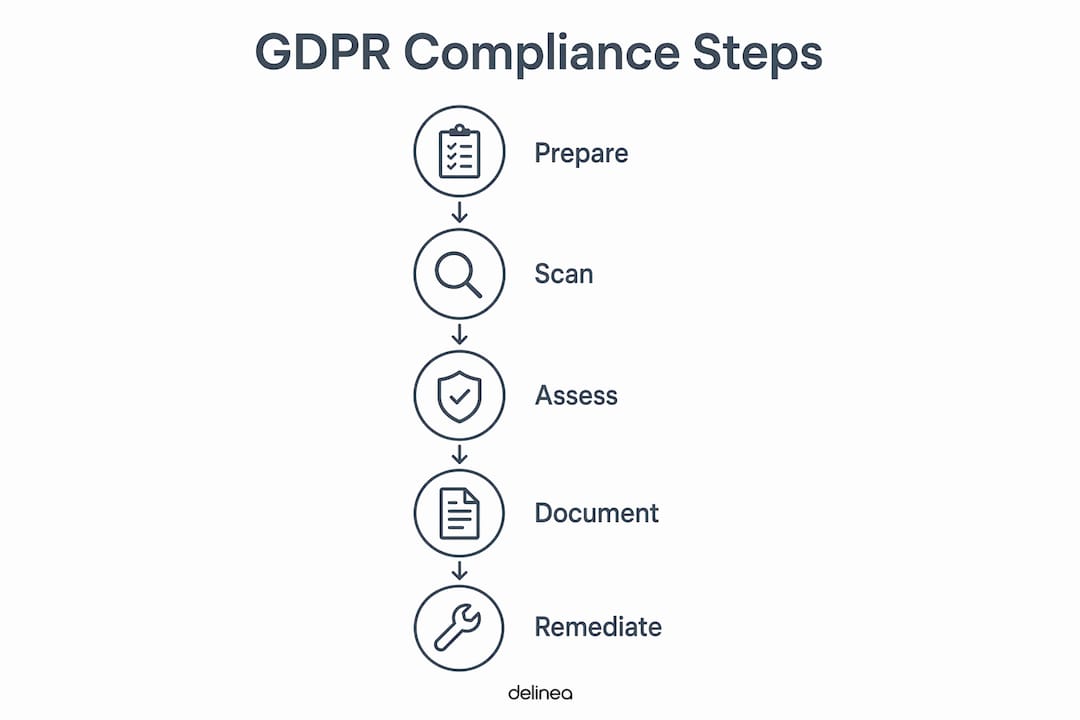
A structured audit procedure produces defensible results. The following sequence applies to most European website owners conducting an internal assessment.
-
Define scope and gather documentation. List every website, subdomain, and third-party service that processes personal data. Collect existing ROPA entries, DPAs, privacy policies, and consent logs before testing begins.
-
Inspect pre-consent network requests. Open your browser’s developer tools and load the site with cookies cleared. Check the Network tab for any requests to analytics platforms, advertising networks, or social media pixels firing before consent is given. Each unauthorized request is a critical finding.
-
Run runtime monitoring for asynchronous trackers. Static single-load tests miss asynchronous trackers loaded via tag managers. Monitor network activity for several seconds after page load and simulate user interactions such as scrolling or clicking to trigger deferred scripts.
-
Review the consent workflow. Test the banner on desktop and mobile. Confirm that accepting and rejecting consent produces the correct script behavior. Verify that consent preferences persist across sessions and that users can withdraw consent from within the site.
-
Audit the privacy policy for accuracy. Cross-reference the policy against your actual data flows. Confirm that every third-party processor named in your ROPA appears in the policy, that retention periods are stated, and that data subject rights are explained clearly.
-
Review data governance documentation. Check that lawful bases are documented for each processing activity, that all processor contracts include the mandatory Article 28 clauses, and that your ROPA is current.
-
Employ automated scanning tools. Automated runtime scanners detect tracking scripts and consent violations at scale. Integrating compliance tests into QA pipelines means cookie consent behavior is verified on every deployment, not just during periodic reviews.
-
Classify findings and assign owners. Produce a structured report with an executive summary, methodology, detailed findings, risk classification, and a remediation plan with named owners and deadlines. A defensible audit report is a regulatory asset, not just an internal document.
Pro Tip: Run the pre-consent network check in an incognito window with browser extensions disabled. Extensions can suppress tracking requests and produce a false-clean result.
What tools and resources support GDPR compliance testing?
GDPR assessment tools fall into two broad categories: automated runtime scanners and manual audit frameworks. Each addresses a different part of the compliance picture.
Automated scanners detect cookies, tracking pixels, and third-party scripts loading on a page. They compare detected technologies against known tracker databases and flag consent violations. These tools work well for public-facing checks but cannot assess documentation quality, lawful basis records, or processor contract completeness.
Manual audit frameworks, typically structured checklists, guide reviewers through data governance requirements. A well-structured cookie compliance checklist covers consent mechanism design, privacy policy content, ROPA completeness, and data subject rights procedures. Checklists are most effective when paired with runtime scanning rather than used in isolation.
| Tool category | What it automates | What it cannot assess |
|---|---|---|
| Runtime cookie scanner | Script detection, pre-consent firing, consent string validation | ROPA completeness, lawful basis records, DPA status |
| Audit checklist | Structured review of governance domains | Dynamic tracker behavior, asynchronous script loads |
| QA pipeline integration | Consent behavior on every deployment | Legal interpretation, organizational procedures |
| Legal review | Regulatory interpretation, DPA drafting | Technical script behavior |
Programmatic automation in CI/CD pipelines provides more reliable control verification than infrequent manual audits. That said, no automated tool replaces legal judgment on questions of lawful basis or data transfer adequacy.
For broader context on how data privacy regulations interact with organizational compliance programs, the regulatory landscape extends well beyond cookie consent into data minimization, purpose limitation, and cross-border transfer rules.
Pro Tip: Use a website audit checklist as a starting framework and add GDPR-specific rows for lawful basis, ROPA status, and DPA coverage. A combined technical and privacy checklist reduces the risk of treating compliance as a separate workstream.
Common pitfalls during GDPR compliance testing
The most frequent errors in GDPR compliance testing are methodological, not technical. Knowing where audits fail helps website owners avoid repeating the same gaps.
-
Relying on static page snapshots. A single page load captures only synchronously loaded scripts. Tag managers routinely defer tracker initialization by several seconds or trigger scripts on user interaction. Runtime monitoring over time is the only reliable detection method.
-
Treating documentation as proof of compliance. Incomplete audit evidence can be used against an organization during a regulatory investigation. A ROPA that lists processing activities without lawful bases, or a DPA that lacks Article 28 clauses, signals non-compliance rather than demonstrating it.
-
Ignoring documentation gaps. Missing ROPA entries and unsigned processor contracts are among the most common causes of audit failure. Many website owners assume that technical controls substitute for governance records. They do not.
-
Treating all findings as equally urgent. A missing cookie description in the privacy policy does not carry the same risk as pre-consent analytics firing. Conflating severity levels leads to wasted effort on minor gaps while critical violations remain open.
-
Conducting one-off audits. Full GDPR compliance programs require quarterly reviews for high-risk processing and annual full-scope audits. A single test provides a point-in-time snapshot. Websites change, third-party scripts update, and new processors are added. Continuous monitoring is the only way to maintain an accurate compliance picture.
Pro Tip: After each audit, assign every critical finding a named owner and a deadline before the report is finalized. Findings without owners rarely get resolved.
Key Takeaways
A GDPR compliance test requires both technical runtime scanning and documented data governance evidence, and neither component alone satisfies regulatory requirements.
| Point | Details |
|---|---|
| Cover all nine audit domains | Surface-level cookie checks miss the governance documentation that regulators examine most closely. |
| Use runtime monitoring | Static page snapshots miss asynchronous trackers loaded via tag managers after the initial page load. |
| Document everything | Article 5(2) GDPR requires evidentiary documentation; assertions of compliance fail audits without supporting records. |
| Classify findings by severity | Prioritize critical gaps for immediate remediation and schedule minor documentation fixes in planned review cycles. |
| Audit continuously | Quarterly reviews for high-risk processing and annual full-scope audits are the recognized best practice standard. |
Why one-off GDPR audits give website owners false confidence
Most website owners I speak with have done a GDPR audit once, usually when they first launched or after a scare about fines. They checked the cookie banner, updated the privacy policy, and considered the matter closed. That approach creates a compliance gap that widens every month.
Websites are not static. Third-party scripts update silently. New marketing tools get added without legal review. A tag manager configuration changes and suddenly an analytics pixel fires before consent. None of that shows up in last year’s audit report.
The other thing I see consistently is organizations treating their audit documentation as a shield. They assume that having a ROPA and signed DPAs means they are protected. Incomplete or poorly managed documentation actually works against you during a regulatory investigation. An auditor who finds a ROPA with blank lawful basis fields does not conclude that the organization is partially compliant. They conclude that the organization cannot demonstrate compliance at all.
The technical side of GDPR testing has become genuinely accessible. Automated scanners, QA pipeline integrations, and structured checklists have lowered the barrier significantly. The harder problem is organizational: getting legal, technical, and operational teams to treat compliance as a continuous process rather than a project with a completion date. That cultural shift matters more than any individual tool.
— Bo
Passiro’s role in supporting GDPR compliance for websites
Passiro is designed to support GDPR and ePrivacy compliance for website owners who need a reliable consent foundation without enterprise pricing.
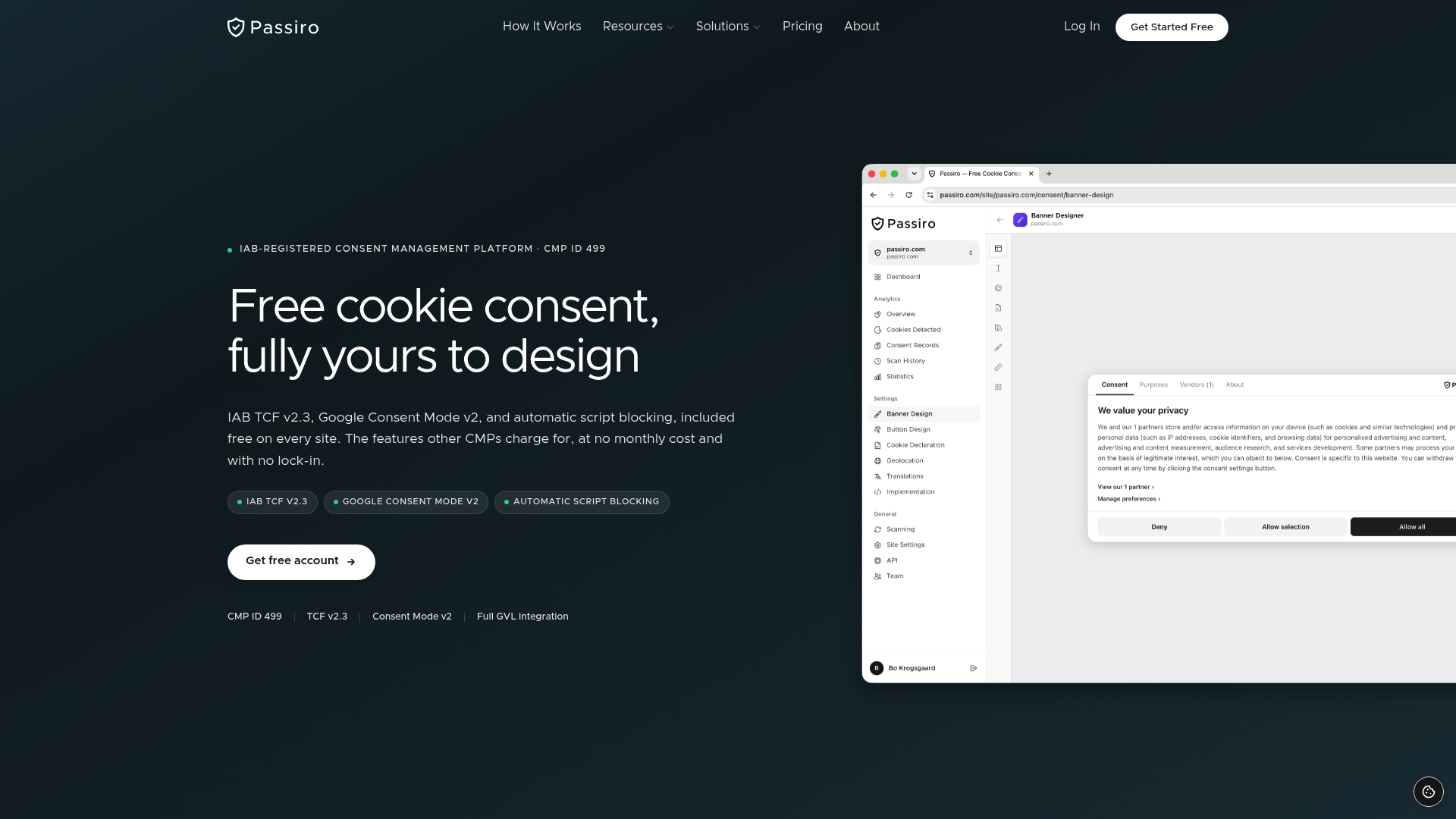
Passiro is a registered IAB TCF v2.3 CMP (ID 499) with Google Consent Mode v2 integration and automatic script blocking. Its tracker database covers 4,900+ entries sourced from EasyPrivacy, updated daily. Geo-targeted banners serve the correct consent experience by region, and the platform supports 25 languages. For WordPress sites, the free WordPress plugin installs in minutes with no page limits or traffic caps. Passiro does not currently offer DSAR automation or vendor risk management. The free tier is permanent and covers unlimited domains.
FAQ
What is a GDPR compliance test?
A GDPR compliance test is a structured assessment of a website’s technical behavior and data governance documentation against the requirements of the General Data Protection Regulation. It covers consent mechanisms, privacy policies, lawful basis records, processor contracts, and data subject rights procedures.
How often should a GDPR compliance test be conducted?
Quarterly reviews for high-risk processing activities and annual full-scope audits represent recognized best practice. Websites that change frequently or add new third-party processors should run targeted checks after each significant update.
Can automated tools fully replace a manual GDPR audit?
Automated tools detect cookie and script behavior reliably but cannot assess documentation quality, lawful basis records, or the legal adequacy of processor contracts. A complete GDPR audit procedure requires both automated scanning and manual governance review.
What does Article 5(2) GDPR require from website owners?
Article 5(2) GDPR requires organizations to demonstrate compliance through documentary evidence, including ROPAs, lawful basis records, and signed Data Processing Agreements. Assertions of compliance without supporting documentation fail regulatory scrutiny.
What is the difference between a critical and a minor GDPR finding?
A critical finding, such as pre-consent tracking or a missing Data Processing Agreement, requires immediate remediation. A minor finding, such as a formatting gap in a privacy policy, can be addressed within a planned review cycle without immediate regulatory risk.
Recommended
- Cookie Disclaimer: A 2026 Compliance Guide for Website Owners | Passiro
- Cookie Regulations – GDPR, ePrivacy, CCPA, and Global Privacy Laws | Passiro
- Cookie Compliance – Your Complete Guide to Cookie Consent and Privacy Regulations | Passiro
- Cookie Compliance Checklist – 25-Point Verification for Your Website | Passiro
Get compliant cookie consent — free
Passiro gives you a compliant cookie banner with IAB TCF v2.3 and Google Consent Mode v2, free on every site.