Cookie Wall Explained: Compliance and Alternatives in 2026

A cookie wall is defined as a consent mechanism that blocks all access to a website until a visitor accepts tracking cookies, offering no meaningful alternative. This “accept or leave” model conflicts directly with the GDPR requirement that consent must be freely given, informed, specific, and unambiguous. Cookie walls generally do not meet GDPR standards because users cannot refuse tracking without losing access entirely. The European Data Protection Board (EDPB) and national data protection authorities across the EU have consistently rejected this model. For website owners and digital marketers operating under GDPR, ePrivacy, CCPA/CPRA, or LGPD, understanding why cookie walls fail and what to use instead is not optional. It is a legal and operational necessity.
What is a cookie wall and why is it controversial?
A cookie wall operates by intercepting visitors before they can view any content, presenting a single choice: consent to all cookies or leave the site. There is no “reject” button, no partial consent, and no way to access the content without agreeing to tracking. This structure is what regulators call a “take it or leave it” consent model.

The practical effect on visitors is significant. A full-screen cookie wall can increase bounce rates by 10%–20%, as visitors leave rather than accept tracking. That is a measurable loss of audience before a single page view is recorded.
Privacy regulators and advocates classify cookie walls as a dark pattern. A dark pattern is a design technique that manipulates users into choices they would not otherwise make. In the context of consent, this includes hiding reject buttons, using gray text for the “decline” option, or simply removing the option altogether. Cookie walls represent the most aggressive form of this practice.
“Consent is only valid under GDPR if the data subject has a genuine free choice and is not penalized for refusing consent. Blocking access to a service because a user refuses cookies removes that free choice entirely.” — European Data Protection Board, Guidelines 05/2020 on Consent
The contrast with a compliant cookie banner is clear. A compliant banner presents accept and reject options with equal visual prominence, allows users to continue browsing with only strictly necessary cookies active, and records the consent decision for audit purposes. A cookie wall does none of these things.
Are cookie walls compliant with GDPR, ePrivacy, and other privacy laws?
The short answer is no, at least under GDPR and the ePrivacy Directive. Regulators explicitly consider cookie walls illegal under GDPR and ePrivacy because they deny access to users who refuse cookies. This position has been reinforced by enforcement actions in France, the Netherlands, and Germany.
The legal framework across jurisdictions differs in important ways, and those differences determine what your consent mechanism must do.
| Regulation | Consent model | Cookie wall status | Enforcing body |
|---|---|---|---|
| GDPR (EU) | Opt-in required | Prohibited | EDPB, national DPAs |
| ePrivacy Directive (EU) | Opt-in required | Prohibited | National DPAs |
| CCPA/CPRA (California) | Opt-out required | Generally permitted | CalPrivacy (CPPA) |
| LGPD (Brazil) | Opt-in required | High risk | ANPD |
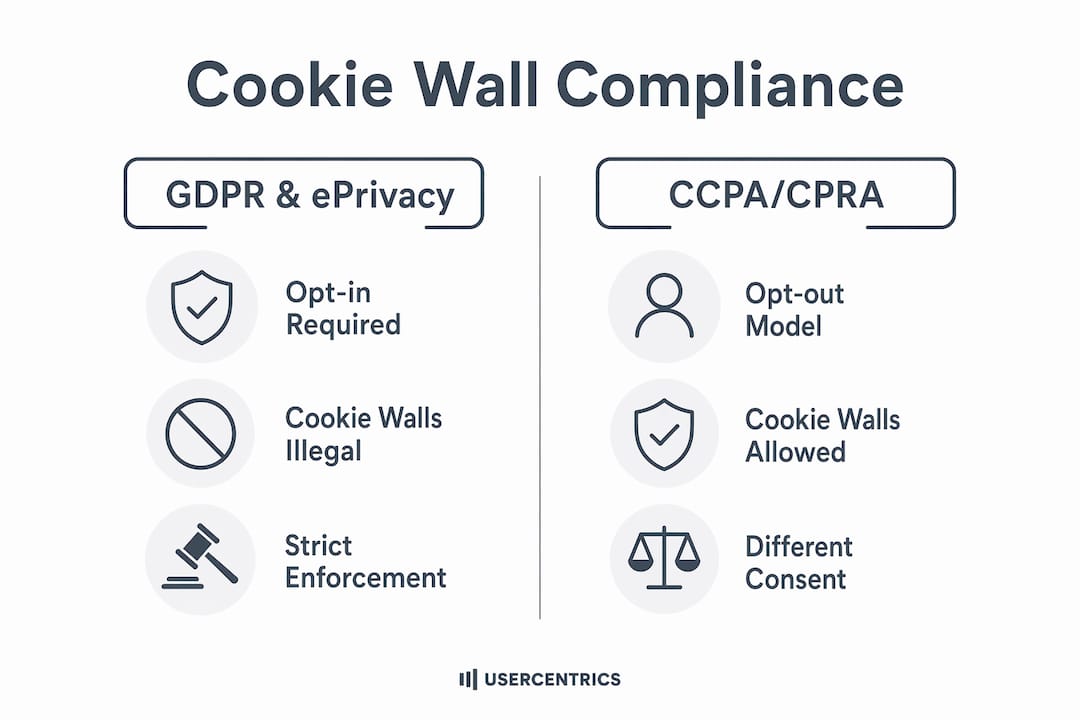
GDPR requires that consent be freely given before any non-essential tracking begins. The ePrivacy Directive reinforces this for cookies specifically, requiring prior informed consent for any cookie that is not strictly necessary for the service requested. Both frameworks treat access denial as coercion, which invalidates consent.
CCPA and CPRA operate differently. California law requires businesses to offer an opt-out of the sale or sharing of personal data, not an opt-in before data collection. A cookie wall is not automatically prohibited under CCPA, but it can still create legal exposure if it is designed to obscure the opt-out right or if it processes data before a user has a chance to exercise that right.
Jurisdiction-specific consent flows are necessary because GDPR requires opt-in while CCPA/CPRA requires opt-out. A single banner configuration cannot satisfy both. Website owners serving visitors from multiple regions need geo-targeted consent logic that applies the correct model based on the visitor’s location.
Dark patterns like asymmetric buttons are increasingly targeted by regulators and can result in significant fines. The French data protection authority (CNIL) has issued fines exceeding €100,000 for consent interfaces that made rejecting cookies more difficult than accepting them.
What are effective alternatives to cookie walls?
The most direct alternative to a cookie wall is a compliant cookie banner that presents accept and reject options with equal visual weight. Symmetrical design of cookie consent options is critical to regulatory compliance and user trust. This means the “reject” button must be the same size, color, and prominence as the “accept” button. Burying the reject option in a secondary menu or rendering it in gray text fails this standard.
Providing easy, visible reject buttons increases trust and can improve acceptance rates over manipulative banners. This is counterintuitive but well-documented. When users feel they have a genuine choice, they are more likely to consent voluntarily. Coercive designs produce inflated consent numbers that do not reflect genuine user intent, which creates both legal risk and unreliable data.
Several design principles reduce friction while maintaining compliance:
- Present accept and reject options at the same visual level, not buried in a “manage preferences” link.
- Use granular consent categories (analytics, marketing, functional) so users can accept some and reject others.
- Avoid pre-ticked checkboxes, which are explicitly prohibited under GDPR.
- Make the consent banner dismissible with a clear “continue without accepting” option where legally required.
- Store consent records with timestamps and version identifiers for audit purposes.
Designing cookie banners as a privacy-first UX feature rather than a conversion mechanism builds user trust and results in more reliable consent data. This reframe matters. A consent banner is not an obstacle to engagement. It is a signal of how a business treats its visitors.
For website owners who want to remove the consent question entirely, switching to privacy-first analytics that do not rely on cookies can eliminate the need for cookie banners altogether. Tools that use aggregated, cookieless tracking methods do not trigger GDPR consent requirements for analytics. This approach also improves website engagement metrics because it removes the friction of a consent banner from the visitor experience.
Pro Tip: If your analytics platform supports cookieless tracking, switching to it for measurement purposes removes the legal requirement for an analytics consent category entirely, simplifying your banner and reducing visitor friction.
How to implement compliant cookie consent without a cookie wall
Building a compliant consent flow requires more than placing a banner on a page. It requires coordinated technical implementation across the entire site.
-
Audit your cookies and categorize tracking scripts. Use a cookie scanner to identify every cookie and third-party script your site loads. Categorize each as strictly necessary, functional, analytics, or marketing. Passiro’s scanner checks against a database of 4,900+ trackers from EasyPrivacy, updated daily, which covers the vast majority of common tracking technologies.
-
Block non-essential scripts before consent is given. Cookie consent banners must technically block non-essential scripts until consent is given to comply with GDPR. This is a technical requirement, not just a design one. If Google Analytics or Meta Pixel loads before a user clicks “accept,” the consent is invalid. Automatic script blocking handles this at the tag level.
-
Design the banner with symmetrical accept and reject options. Apply the design principles from the previous section. Test the banner on mobile and desktop to confirm the reject option is equally accessible on both.
-
Configure jurisdiction-specific consent logic. Visitors from EU member states must receive an opt-in banner. Visitors from California must receive an opt-out mechanism that honors the Global Privacy Control (GPC) signal. GPC is a browser-level opt-out signal that CCPA/CPRA requires businesses to respect automatically. Passiro’s geo-targeted consent banners apply the correct consent model based on the visitor’s detected location.
-
Respect browser opt-out signals. GPC and similar signals must be detected and honored server-side or at the consent management layer. Ignoring GPC signals is a CCPA violation.
-
Test and audit the consent flow regularly. Consent implementations drift over time as new scripts are added to a site. Improper implementation of multiple cookie consent plugins can break site JavaScript and disrupt user experience. Run a cookie audit after every major site update to confirm that script blocking still functions correctly and that no new trackers have been added outside the consent framework.
Pro Tip: Run your site through a cookie scanner before and after any plugin or theme update. New plugins frequently add tracking scripts that bypass your existing consent configuration.
Building trust online depends on consistent, transparent data practices. A consent flow that works correctly every time is a visible signal of that consistency.
Key Takeaways
A cookie wall is prohibited under GDPR and ePrivacy because it removes the user’s free choice, making any consent collected through it legally invalid.
| Point | Details |
|---|---|
| Cookie walls violate GDPR | Blocking access until cookies are accepted removes freely given consent, which GDPR requires. |
| Bounce rates increase measurably | Full-screen cookie walls raise bounce rates by 10%–20%, reducing audience reach before any content is viewed. |
| Symmetrical design is required | Accept and reject buttons must carry equal visual weight to satisfy EDPB guidance and avoid dark pattern classification. |
| Jurisdiction logic is mandatory | GDPR requires opt-in; CCPA/CPRA requires opt-out. One banner configuration cannot satisfy both without geo-targeting. |
| Script blocking is a technical requirement | Non-essential scripts must not load before consent is recorded, or the consent is invalid under GDPR. |
My honest view on cookie walls and where consent is heading
I built Passiro because I ran websites across multiple jurisdictions and watched the consent management industry charge enterprise prices for what is, technically, a lightweight JavaScript widget. Cookie walls were part of that problem. They were presented to site owners as a way to “protect” consent rates, when in reality they were protecting ad revenue at the expense of user trust and legal standing.
The data tells a clear story. A cookie wall that increases bounce rates by 10%–20% does not protect your business. It damages it, and it does so while creating regulatory exposure that can result in fines that dwarf any ad revenue recovered. I have never seen a cookie wall that was worth the risk.
What I expect to see in 2026 and beyond is accelerating enforcement. The EDPB has been explicit about cookie walls for years. National data protection authorities now have the enforcement infrastructure to act on complaints at scale. The French CNIL, the Irish DPC, and the Dutch AP have all demonstrated willingness to fine organizations for consent dark patterns. Cookie walls are the most visible dark pattern in this space.
The future of consent is privacy-first by default. Cookieless analytics, granular opt-in banners, and automatic GPC signal recognition are not advanced features. They are the baseline that regulators expect. Website owners who treat consent as a trust signal rather than a conversion obstacle will be better positioned legally and commercially as enforcement intensifies.
— Bo
Passiro supports compliant consent for every website
Passiro is a registered IAB TCF v2.3 CMP (ID 499) built to support GDPR, ePrivacy, CCPA/CPRA, and LGPD compliance without enterprise pricing. The free tier covers unlimited domains and traffic, with no page limits or expiry.

Passiro includes automatic script blocking, Google Consent Mode v2, geo-targeted banners across 25 languages, and a cookie scanner backed by a 4,900+ tracker database updated daily. For WordPress sites, the free WordPress plugin installs in minutes and handles script blocking automatically. For Wix, Squarespace, and Webflow users, cookie consent for website builders is available at no cost. Passiro does not currently offer DSAR automation or vendor risk management. For teams that need only compliant consent, it covers the core requirement, free, permanently.
FAQ
What is a cookie wall?
A cookie wall is a consent mechanism that blocks website access until a visitor accepts all tracking cookies, offering no option to refuse and continue browsing.
Are cookie walls legal under GDPR?
Cookie walls are prohibited under GDPR and the ePrivacy Directive because they deny access to users who refuse cookies, which removes the freely given consent that both laws require.
How do cookie walls affect bounce rates?
A full-screen cookie wall can increase a website’s bounce rate by 10%–20%, as visitors leave rather than accept tracking conditions they did not choose.
What is the compliant alternative to a cookie wall?
A compliant cookie banner presents accept and reject options with equal visual prominence, blocks non-essential scripts until consent is given, and stores a timestamped consent record for audit purposes.
Does CCPA prohibit cookie walls?
CCPA and CPRA do not explicitly prohibit cookie walls, but they require businesses to honor opt-out signals like Global Privacy Control (GPC) and to provide a clear mechanism for users to opt out of the sale or sharing of personal data.
Recommended
Get compliant cookie consent — free
Passiro gives you a compliant cookie banner with IAB TCF v2.3 and Google Consent Mode v2, free on every site.