GDPR Compliance Tester: 2026 Guide for Website Owners

What is a GDPR compliance tester and why does it matter?
A GDPR compliance tester is an automated scanning tool that visits your website, detects cookies and tracking technologies, and produces a diagnostic report identifying potential data protection risks. These tools simulate real user visits using headless browsers, checking for unauthorized cookie placement, missing or non-compliant consent banners, insecure data transmissions, and absent privacy policy disclosures. Most complete a scan in under 60 seconds, returning findings mapped to specific GDPR articles so you can prioritize remediation.
What these tools do not do is equally important to understand. No automated scanner issues legal certification, and no GDPR certification scheme currently exists under EU law. A tester gives you a risk posture, not a compliance guarantee. For website owners and managers, that distinction shapes how scan results should be used: as a structured starting point for a broader compliance program, not as a substitute for legal review.
Common issues these tools detect include:
- Cookies firing before a user grants consent (a direct violation of Article 7)
- Missing or inadequate consent banners lacking granular opt-in controls
- Third-party trackers loading without disclosure in the privacy policy
- Absent or incomplete privacy policy pages
- Missing data controller identification or contact details
- Insecure cookie attributes (no Secure or HttpOnly flags)
- Failure to honor consent withdrawal or opt-out signals
Comparing the leading GDPR compliance testing tools
The market for GDPR compliance software ranges from free one-page scanners to enterprise platforms combining consent management, security assessment, and continuous monitoring. The table below covers the major options available in 2026.

| Tool | Key Features | Pricing | Scan Scope | Free Option | Regulations Supported | Best For |
|---|---|---|---|---|---|---|
| Cookiebot | Cookie detection, regulatory reports, consent management | Paid tiers (free trial available) | Cookies, trackers, consent banners | Free trial | GDPR, ePrivacy, CCPA | Broad cookie and tracker detection |
| Usercentrics | Consent management, real-time alerts, GDPR scanning | Paid tiers | Consent flows, cookie audit | Free trial | GDPR, CCPA, LGPD | Integrated consent management |
| CookieYes Compliance Checker | Basic cookie scan, straightforward interface | Free | Cookies, consent banners | Free | GDPR, ePrivacy | Small sites needing quick scans |
| Compliance Checker by CookieYes | Detailed cookie and banner compliance reports | Free | Cookies, banner audit | Free | GDPR, ePrivacy | Deeper cookie compliance reports |
| ICO Checklists | Governance self-assessment, structured checklists | Free | Governance, rights, security, data sharing | Free | UK GDPR | Medium organizations needing governance frameworks |
| Blackkite GDPR Compliance Checker | Cybersecurity risk integration, GDPR posture scoring | Paid | Security posture, GDPR risk | — | GDPR, security frameworks | Enterprises needing security and privacy combined |
| ImmuniWeb Security Test | Web security and GDPR scanning combined | Free tier available | Security headers, GDPR, privacy | Free tier | GDPR, PCI DSS, HIPAA | Sites prioritizing security alongside privacy |
| Sovy | Cookie consent checks, compliance scoring | Paid (free scan) | Cookies, consent mechanisms | Free scan | GDPR, ePrivacy | User-friendly compliance scoring |
| 2GDPR | Rapid issue detection, remediation advice | Free | Common GDPR issues | Free | GDPR | Small to mid-size website owners |
| Iubenda GDPR Compliance Checker | Integrated with Iubenda consent tools | Free checker | Cookies, privacy policy, consent | Free | GDPR, CCPA, LGPD | Sites already using Iubenda |
| Insites | Tracker database reporting, cookie audit | Paid | Cookie tracking insights | — | GDPR | Businesses needing tracker detail |
| AesirX Privacy Scanner | Free privacy risk diagnostics, gap analysis | Free | GDPR and privacy risk exposures | Free | GDPR, ePrivacy | Free risk diagnostics |
| CookieYes GDPR Cookie Checker | Cookie scan with compliance summary | Free | Cookies, consent banners | Free | GDPR, ePrivacy | Quick cookie compliance checks |
Pro Tip: Run the same URL through two or three free tools such as 2GDPR, AesirX Privacy Scanner, and the CookieYes Compliance Checker before committing to a paid platform. Comparing outputs reveals which issues are consistent across scanners and which may be false positives.
A few tools deserve closer attention based on their distinct positioning.
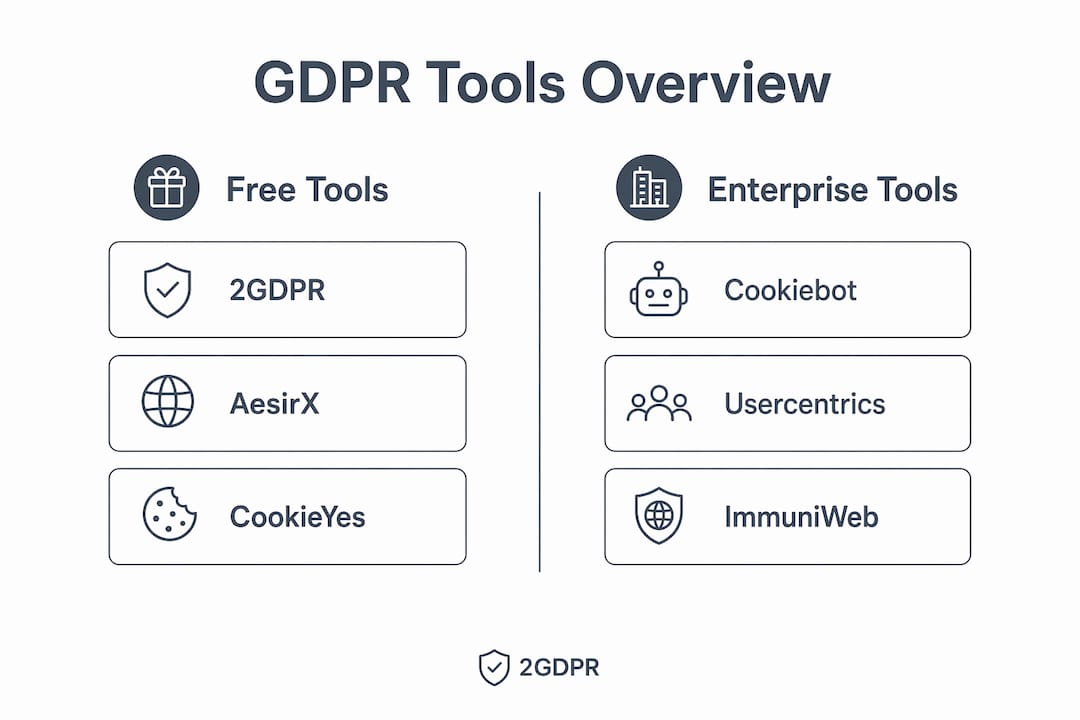
Cookiebot and Usercentrics both combine scanning with active consent management, meaning they detect issues and then offer the infrastructure to fix them within the same platform. That integration is convenient but creates a commercial dependency: the scan findings naturally point toward their own paid consent solutions.
ICO Checklists occupy a different category entirely. Rather than scanning your site technically, the UK Information Commissioner’s Office provides structured self-assessment frameworks covering governance, lawful bases, data subject rights, and security. These structured self-assessments carry more regulatory weight than a technical scan alone, because they document your organization’s accountability posture across the full scope of UK GDPR obligations.
Blackkite and ImmuniWeb approach compliance from a security angle, integrating GDPR risk scoring with broader cybersecurity posture evaluation. For organizations handling sensitive personal data, that combination is more informative than a cookie-only scan.
AesirX Privacy Scanner and 2GDPR are the most accessible entry points: both are free, require no account creation, and return results quickly. They suit website owners who need an immediate snapshot before investing in a more thorough assessment.
How to interpret your scan results and what to do next
Scan results typically arrive as a risk score, a list of flagged issues, and a set of remediation hints. The challenge is knowing which findings require immediate action and which represent lower-priority gaps.
Start by mapping flagged issues to specific GDPR articles. A cookie firing before consent maps to Article 7 (conditions for consent). A missing privacy policy maps to Articles 13 and 14 (transparency obligations). If the scanner flags high-risk data processing activities, that may indicate the need for a Data Protection Impact Assessment under Article 35. Automated tools can flag when a DPIA might be warranted, but they cannot conduct one. A DPIA is a rigorous manual process requiring documented analysis of processing necessity, proportionality, and risk mitigation.
Automated scanners detect technical cookie violations but cannot evaluate internal policies or the validity of your lawful basis for processing. That boundary matters. A scanner might confirm your consent banner is present, but it cannot verify whether the consent collected is genuinely unambiguous and freely given under Article 4(11). Those determinations require human legal judgment.
Practical actions after receiving scan results:
- Verify that no cookies or scripts fire before a user interacts with the consent banner
- Check that your consent mechanism offers genuine granular choice, not pre-ticked boxes or bundled consent
- Update your privacy policy to disclose all third-party processors identified in the scan
- Confirm data controller contact details appear on your privacy policy page
- Review security headers flagged by the scanner (Content Security Policy, HSTS, Secure cookie attributes)
- Schedule a manual review of your Records of Processing Activities if the scan reveals undisclosed data flows
- Plan a governance review using a structured framework such as the ICO self-assessment checklists for issues the scanner cannot reach
Mature compliance programs use continuous automated monitoring with integrated alerts rather than isolated scans. A single scan captures a point-in-time snapshot; third-party scripts and tracking pixels change frequently, and a site that passed a scan in january may have new violations by march.
GDPR, ePrivacy, and what compliance testers can legally verify
Understanding what a GDPR compliance tester actually measures requires understanding the two legal frameworks it touches.
The ePrivacy Directive governs cookies and tracking technologies, requiring prior informed consent before any non-essential cookie is placed on a user’s device. GDPR then governs what happens to the personal data collected through those cookies: how it must be protected, how long it can be retained, and what rights individuals hold over it. Cookie banner compliance satisfies part of the ePrivacy obligation, but it does not address the full scope of GDPR requirements.
Compliance testers focus on the technical layer: what cookies fire, whether a banner exists, whether security headers are configured correctly. They cannot verify:
- Whether your stated lawful basis for processing is legally valid
- Whether your data retention periods are proportionate and documented
- Whether your data processor agreements with third parties meet Article 28 requirements
- Whether your organization can respond to data subject access requests within the statutory timeframe
- Whether your Records of Processing Activities are complete and current
- Whether staff have received adequate data protection training
Compliance assessments that document risk identification carry more regulatory weight than casual self-reviews. Regulators assessing accountability under Article 5(2) look for evidence of structured, documented compliance activity. A scan report from a recognized tool contributes to that evidence base, but only as one component alongside governance documentation, training records, and legal review.
The misconception that a passing scan score means a site is “GDPR compliant” is common and legally problematic. Supervisory authorities across the EU and UK have consistently enforced against organizations whose technical implementations appeared correct but whose underlying data handling practices were not.
How GDPR compliance testers actually scan your website
The technical process behind a GDPR compliance tester is more sophisticated than a simple page crawl. Understanding it helps you interpret results accurately and recognize their limits.
Most scanners deploy a headless browser to simulate real user visits, loading the target URL in a controlled environment that records every network request, cookie placement, and script execution. The browser walks the DOM, replays consent flows by interacting with the consent banner, and inspects HTTP response headers. This approach captures cookies that fire before consent is granted, which a static HTML analysis would miss entirely.

| Scan Component | What It Detects | GDPR Relevance |
|---|---|---|
| Pre-consent cookie audit | Cookies and scripts executing before user interaction | Article 7 consent conditions |
| Consent banner validation | Banner presence, granularity, reject option, dark patterns | Article 4(11), ePrivacy Directive |
| Privacy policy check | Policy presence, data controller identification, contact details | Articles 13, 14 transparency |
| Security header analysis | CSP, HSTS, Secure/HttpOnly cookie flags, TLS version | Security of processing |
| Third-party tracker detection | Undisclosed processors, cross-site tracking pixels | Articles 13, 28 processor obligations |
| DSA transparency check | Ad disclosure, complaint mechanism presence | Digital Services Act obligations |
Scan results are typically delivered in HTML, JSON, or PDF format, with each flagged rule carrying a regulation reference, the evidence collected, and a remediation hint. Deterministic scanning, where the same URL produces the same result on repeated runs, is a quality indicator worth checking when evaluating tools. Flaky scanners that return different results for the same URL introduce uncertainty into your compliance records.
Pro Tip: Tools built on real browser engines such as Playwright or Puppeteer capture dynamic cookie behavior that server-side or static scanners miss. When evaluating a GDPR audit tool, confirm it uses a real browser rather than a simple HTTP request library.
What scanners cannot detect is equally important to document. Internal data handling policies, employee access controls, data retention enforcement, and the validity of consent records stored in your consent management platform all fall outside the scope of any automated scan. Automated tools excel at detecting cookie-related technical issues but require manual audits to assess legal processing bases and internal governance compliance.
Practical guidance for using GDPR compliance testers effectively
Automated GDPR compliance testers are a reliable diagnostic first step, not a complete compliance program. Used correctly, they surface the technical issues most likely to draw regulatory attention and give you a structured remediation list.
The most effective approach treats scanning as a recurring activity rather than a one-time exercise. Website code changes, third-party scripts update, and new tracking pixels appear without notice. A scan that confirmed clean results three months ago may not reflect your site’s current state. Continuous automated monitoring with real-time alerts for unauthorized trackers is the direction mature compliance programs are moving, and several tools in this guide offer that capability at the paid tier.
Combine automated scanning with independent assessments for stronger accountability. The ICO’s self-assessment checklists address governance dimensions that no technical scanner reaches, including your organization’s ability to handle data subject requests, your data sharing agreements, and your security policies. Running both in parallel gives you a more complete picture of your compliance posture.
Key guidance for website owners and managers:
- Use free tools such as 2GDPR or AesirX Privacy Scanner for an immediate baseline assessment
- Treat any scan report as evidence of documented compliance activity, not as proof of full compliance
- Re-scan after any significant website update, new third-party integration, or plugin addition
- Pair technical scan findings with a governance review covering lawful basis, RoPA, and DSAR procedures
- Retain scan reports as part of your accountability documentation under Article 5(2)
- Consider tools with continuous monitoring if your site changes frequently or carries high-risk processing
For cookie compliance regulations covering GDPR, ePrivacy, CCPA, and other applicable laws, the legal context behind each scan finding matters as much as the finding itself. Understanding which regulation a flagged issue relates to determines the urgency and the appropriate fix.
Passiro offers free cookie consent for websites of any size
The tools compared above identify compliance gaps. Passiro addresses one of the most commonly flagged: the absence of a properly implemented consent management platform.
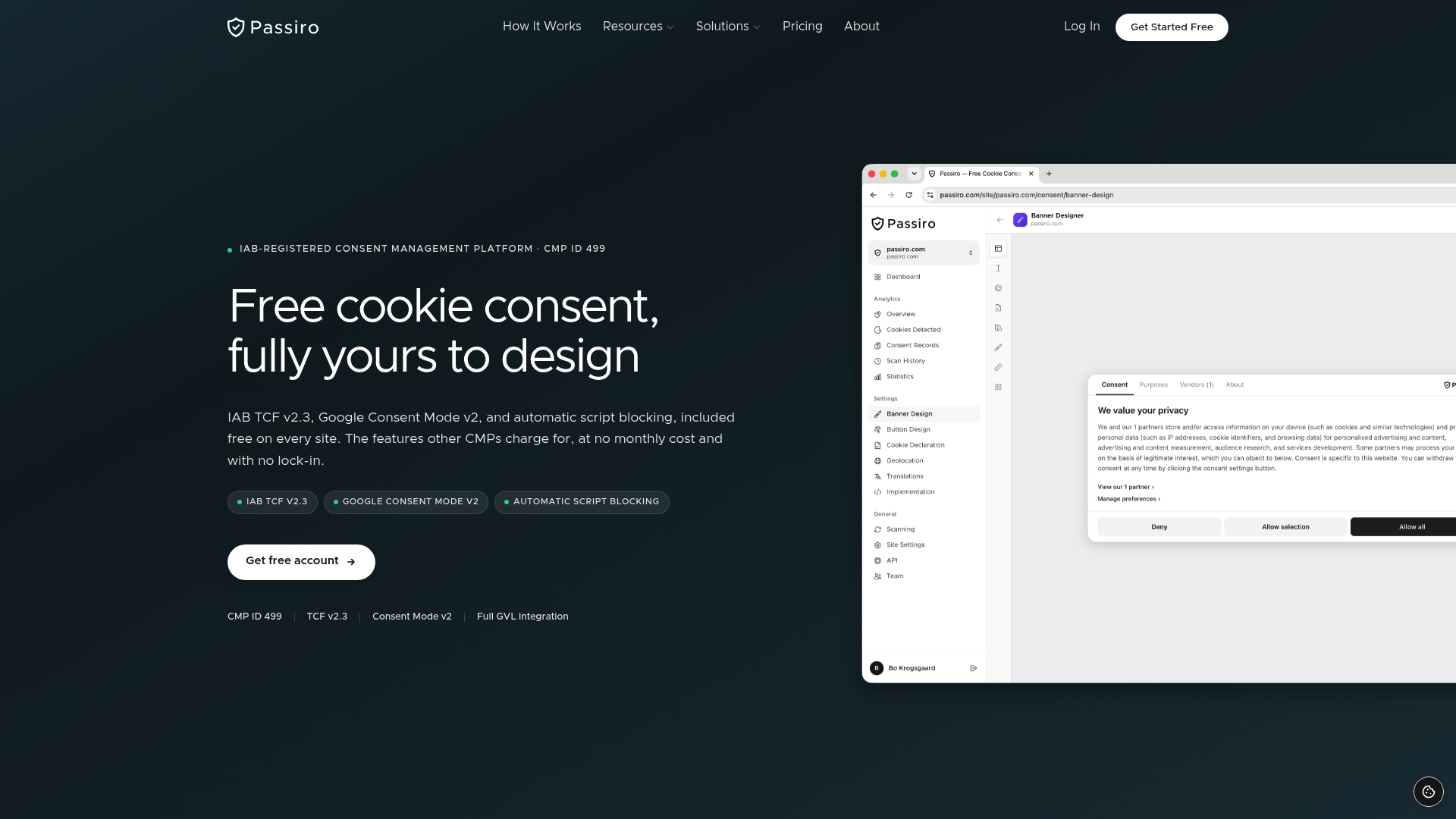
Passiro is a free, permanently available consent management platform designed to support GDPR and ePrivacy compliance, with additional support for CCPA/CPRA and LGPD. It is a registered IAB TCF v2.3 CMP (ID 499) and supports Google Consent Mode v2, automatic script blocking, and a tracker database of 4,900+ entries sourced from EasyPrivacy and updated daily. The free tier covers unlimited domains and unlimited traffic, with no page limits and no expiry. Paid plans add consent analytics, white-labeling, and API access, funding the free tier for everyone else. Two genuine limitations: Passiro does not currently offer DSAR automation or vendor risk management, so organizations needing those capabilities will require additional tools.
If your scan results flag missing or non-compliant consent infrastructure, free cookie consent from Passiro is a direct path to addressing that finding. WordPress users can deploy it via the free WordPress plugin without touching code.
Key Takeaways
A GDPR compliance tester is a diagnostic tool, not a legal certification, and its value depends entirely on how you act on the findings it surfaces.
| Point | Details |
|---|---|
| Testers are diagnostic, not certifying | No automated scanner provides legal GDPR certification; findings indicate risk posture only. |
| Pre-consent cookie firing is the top issue | Cookies executing before user consent is granted directly violate Article 7 conditions. |
| ePrivacy and GDPR operate together | Cookie banner compliance satisfies ePrivacy requirements but does not cover full GDPR obligations. |
| Manual review is always required | Scanners cannot assess lawful basis validity, RoPA completeness, or DSAR readiness. |
| Passiro addresses consent infrastructure | Passiro’s free CMP (IAB TCF v2.3, ID 499) directly resolves the consent banner gaps most scanners flag. |
Recommended
Get compliant cookie consent — free
Passiro gives you a compliant cookie banner with IAB TCF v2.3 and Google Consent Mode v2, free on every site.