


Conversions dropped after a cookie-banner change? Check these 7 things first
The new banner went live on Monday. By Thursday, Google Ads showed fewer conversions. Should you reverse the release, increase the budget or pause the campaign?
Start by separating a business change from a measurement change. Compare the underlying orders or qualified leads with the advertising report, then inspect consent signals and conversion events. A drop after a banner change is a useful clue, but timing alone does not establish the cause.
This guide is for marketers using GA4 and Google Ads. Start with the overview, then work through the checks with the person who owns the implementation before making a large budget decision.
Quick troubleshooting overview
Work through the checks in this order. The first two show whether anything changed beyond the report; the rest help you locate the cause.
| Check | What to compare | What it tells you |
|---|---|---|
| Actual business result | What to compareOrders or qualified leads in your order system or CRM, before and after the release. | What it tells youWhether sales fell or only the report changed. |
| Comparable reports | What to compareConversion action, date range, time zone, attribution window and reporting delay. | What it tells youWhether you are comparing like with like. |
| Consent defaults and updates | What to compareThe consent state before a choice and after accept, reject and change, in Tag Assistant. | What it tells youWhether the signals follow the visitor’s choice. |
| Mode (Basic or Advanced) | What to compareWhich Google tags load before consent now and before the release. | What it tells youWhether the release changed what Google receives before consent. |
| Event firing | What to compareA test purchase or lead after granting consent. | What it tells youWhether the conversion fires once, with the right value. |
| Modeling status | What to compareGoogle Ads Diagnostics and the GA4 property’s modeling eligibility. | What it tells youWhether estimates are active, not yet active or not available. |
| Traffic mix | What to compareConsent choices by device, market and campaign, using the same measure. | What it tells youWhether a different audience is making different choices. |
1. Check whether sales or leads actually fell
Use your order system or CRM to establish the business outcome. Match the time period and account for refunds, cancellations, duplicate leads and the difference between a submitted form and a qualified opportunity.
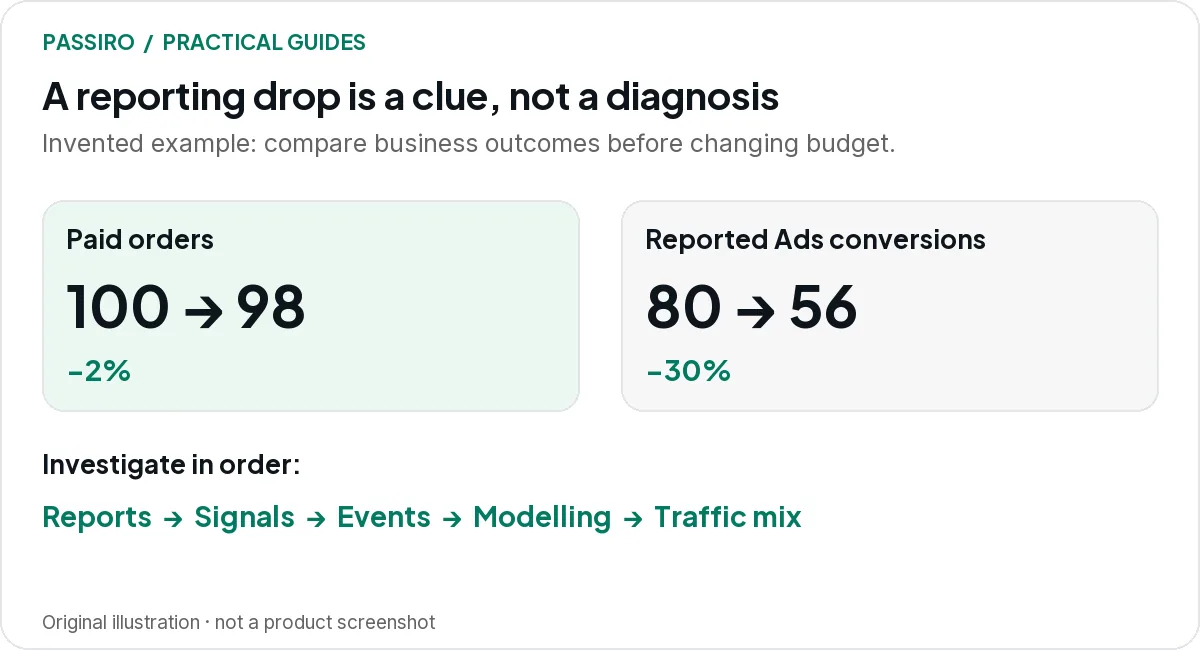
Illustrative example: a shop has 100 paid orders before the release and 98 after it, while Google Ads conversions fall from 80 to 56. Reported conversions fell 30%; paid orders fell 2%. Those numbers do not prove a tracking fault, but they justify investigating measurement before blaming demand.
In real analysis, compare equivalent periods and account for other changes such as spend, promotions and traffic mix.
2. Make the reports comparable
Check conversion definitions, date attribution, time zones, attribution windows and reporting delays. Confirm that the same conversion action is selected and that its primary or secondary status has not changed.
GA4 and Google Ads do not have to show identical totals. Google’s GA4 reporting-identity guidance explains how identity options affect the way users are represented, including modeling in blended reporting.
Leave the most recent days out of a first comparison. Google says modeled conversions can take up to five days to process fully in Google Ads reporting.
Write down the comparison you are making. “Sales are down in analytics” is not precise enough to debug.
3. Inspect defaults and updates
Open a fresh session with Tag Assistant and inspect the consent timeline. Confirm the intended default state, then accept, reject and change preferences in separate test journeys.
Look at all four v2 signals. A missing update can leave tags in a denied state even after a visitor grants the relevant permission. An incorrectly granted default is a different problem and should not be treated as a way to restore reporting volume.
Use Google’s consent-debugging guide to check the sequence, and compare the observed result with the mapping agreed for your banner. If you use Passiro, our Support Center shows how to verify Google Consent Mode with Tag Assistant.
4. Confirm whether Basic or Advanced changed
A release can accidentally change which tags load before consent. Someone may also have added a blanket block to a configuration that previously used Advanced mode.
Find out which behavior was intended before changing it again. Ask the implementation owner to show a fresh visit and a rejected visit. Our Basic vs Advanced guide explains what you should expect in each.
Do not switch to Advanced merely to make a chart rise. That choice changes what Google receives before consent and needs to match the site’s requirements.
5. Test the event after a real interaction
Allow the relevant consent, then complete a test purchase or lead submission. Does the event fire once, reach the intended destination and contain the right value?
Inspect pages outside the main site too. A checkout, booking tool or form on another domain may have a separate implementation. A tag can also miss the first eligible event if it waits for a trigger that already happened before consent changed.
Give the developer the specific failure: the page, the choice, the interaction and the expected event. That is more useful than asking them to “fix Consent Mode”, and the incident report at the end of this guide has a line for each.
6. Separate implementation from modeling eligibility
In Google Ads, open the Diagnostics tab of a website conversion action. Google shows one status when Consent Mode is implemented and another when modeling is also active. Its verification guidance currently sets a threshold of 700 ad clicks over seven days for each domain and country grouping, and says the status can take 48 hours, occasionally up to two weeks, to appear.
Check GA4 behavioral modeling separately. Google’s prerequisites include Consent Mode on all pages with Google tags loading in all cases (an Advanced implementation), at least 1,000 events per day with analytics_storage denied for at least seven days, and at least 1,000 daily users sending events with analytics_storage granted for at least seven of the previous 28 days. Google notes that meeting them does not guarantee eligibility.
A smaller property may therefore have a correct implementation without the modeled reporting someone expected. Do not promise that waiting a week will fix every account.
7. Review consent choices and traffic mix
If the technical setup behaves as intended, compare banner interactions across equivalent audiences. A campaign sending more mobile traffic or visitors from another market can change the pattern of consent choices.
In Passiro, consent analytics shows acceptance, rejection and category opt-in rates over time, by country and by banner version. Our Support Center explains how to read your consent statistics and why they differ from analytics reports.
Check the banner itself for broken controls, unreadable text or an accidental layout change. Correcting a misleading old design may also reduce acceptance. Do not bring back a hidden reject option, pre-ticked choices or another dark pattern to raise measurement: that is not an acceptable fix.
Keep the denominator clear. “Acceptance among people who interacted” and “acceptance among all banner impressions” are different measures. Record which one you are comparing, then investigate the segment that changed.
Send a short incident report
Fill in this report while you work through the checks and send it to the person who owns the implementation. It is quicker to act on than a long email chain.
Conversion-drop incident report
Release date and time:
Affected report and conversion action:
CRM or order comparison (same period):
Test URL:
Consent choice made:
Action taken in the test:
Expected event and destination:
Observed error:
Owner:
Once the issue is fixed, add the verified repair and a date to check the reports again. If the cause was a duplicate tag or a missing update, the next person can then recognize it quickly.
Two quick questions
Should I add estimated missing sales to Google Ads conversions?
No. Do not manually top up a reported total with an assumed loss, or add modeling again when the report already includes it. Keep any separate planning scenario clearly labeled.
Can a new cookie banner improve ROAS?
It can change measurement and the signals available to eligible advertising systems. That is not a guaranteed improvement in actual revenue or profit. Evaluate business outcomes and measurement quality separately.